Why Tax Season Is Actually an Ownership Architecture Review
What your tax return is really telling you about the durability of your business

Tax Day is approaching. For most business owners, this time of year is treated as a compliance exercise: gather the documents, file the return, write the check, and move on. It is often seen as a backward-looking chore—a settling of debts with the past.
However, after my recent conversation with Michael Reeder of Reeder CPA Group on The Corporate Refugee podcast, I couldn’t stop thinking about a deeper reality. For the sophisticated operator, tax season is not merely about reporting history; it is about designing what comes next.
This shift in perspective comes from living on both sides of the table. I spent 18 years in technology sales inside corporate environments where compensation, tax withholding, and financial planning were largely automated. Then, I spent six years as a franchise owner, learning firsthand that April feels very different when the business is your responsibility. What once felt like paperwork became a direct reflection of every decision I made regarding pricing, payroll, debt, and reinvestment. Now, as a franchise advisor, I see the same pattern repeat: people underestimate how much their tax return reveals about the structural integrity of the life and business they are building.
This April arrives against a sobering economic backdrop. According to the 2026 Edelman Trust Barometer, only 32% of people globally believe the next generation will be better off, while fears of recession and job loss have reached all-time highs. In an environment defined by such uncertainty, tax season becomes more than a filing deadline; it becomes a forced moment of economic clarity.
For the owner, the candidate, and the future “corporate refugee,” this is one of the most important strategic checkpoints of the year. Taxes reveal a truth many miss: The architecture of your business is already shaping your future outcome. Your return is a mirror reflecting how cash moved through the system, where friction appeared, what the business preserved, and what it made possible next. This is why I view April 15 as an annual Ownership Architecture Review.
Tax Season Is an Architecture Review (Pillar 3)
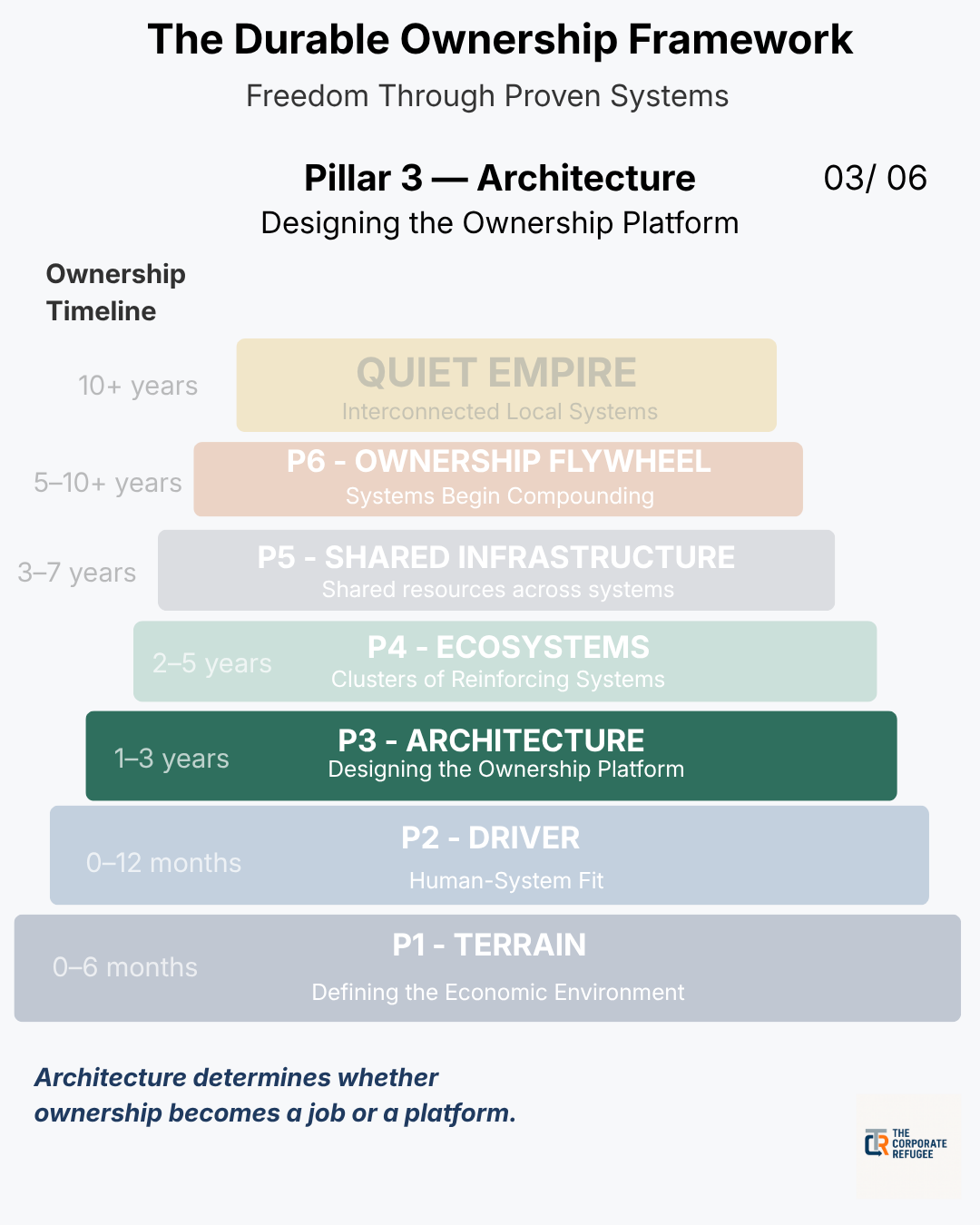
Most people think taxes are about reporting; I believe they are about Architecture. This is where the Durable Ownership Framework becomes practical. Pillar 3—Architecture—is about how the system is designed to support the owner over time. Tax season provides a forced diagnostic moment to review the structural health of your platform:
Cash Flow Velocity: How is cash actually moving through the system, and where is it getting trapped?
Working Capital: Is your capital base too tight to support the next “ramp” or expansion phase?
Debt Compression: Is debt service currently compressing your operational flexibility?
Entity Alignment: Does your current structure (LLC, S-Corp, C-Corp) still align with your long-term wealth goals?
Stewardship: Are compensation and distributions serving the business’s growth or simply starving it?
This is the hidden question beneath every return: Is the business still functioning as a job, or has it begun to function as a system?
I learned this the hard way. Early in my ownership journey, I was focused on top-line growth and team leadership. But tax season had a way of cutting through the story I was telling myself. It forced me to confront what the business was actually producing after payroll pressure, rent, debt, and operational friction.
As I often write: Units do not scale—systems do. Your return tells you which one you currently have. If margins compressed or debt payments choked reinvestment capacity, that is not failure—it is a signal. The return is the scoreboard, but the vital question is: What is that structure telling you about your next chapter?
What April 15 Actually Measures
Tax Day does not simply measure income; it measures design. It is the ultimate audit of your decision-making quality over the previous twelve months. It measures:
Entity Efficiency: Are you losing capital to unnecessary tax friction?
Capital Allocation: How effectively did you deploy your free cash flow?
Owner Draw Discipline: Did you treat the business like an ATM or a compounding engine?
Reinvestment Capacity: Do you have the dry powder required to fund the next unit?
Depreciation Strategy: Are you utilizing tools like Section 179 to accelerate your flywheel?
For the candidate, this season reveals readiness. For the owner, it reveals durability. For the platform builder, it reveals whether capital is being deployed intentionally. April 15 should be treated as a Durability Checkpoint. The question is no longer “What do I owe?” but rather: “What did the system produce, preserve, and position?”
For Candidates: Structure Before Signature
If you are still in the evaluation stage, Tax Day is the single best moment to pause. Before signing an FDD, touching retirement assets, or getting emotionally attached to a brand, ask: What does my current tax picture say about my readiness?
Michael Reeder emphasized a critical distinction: It is not about qualification; it is about readiness. Your current return can tell you more than any “discovery day” ever will. Before you step into the “Driver” seat of a new machine, you must audit your own “Operating System” :
Air Cover: What does your W-2 income tell you about your personal financial runway?
Survival Liquidity: Does your cash position support the first 18–24 months of a ramp?
Funding Optimization: What does your tax bracket suggest about SBA financing versus a ROBS structure?
Net Working Capital: How much capital do you realistically have after taxes, debt, and life obligations?
Too many candidates start with the brand. But the architectural decision—how you fund and house that business—determines your runway long after the grand opening. Resumes don’t run businesses; systems do. Ironically, the return sitting on your desk is often the most important due diligence document in the room.
Tax Planning as Capital Allocation (Pillar 6)
This is where the Ownership Flywheel begins. Wealth is not created by top-line revenue; it is created by what remains after taxes and debt service. Pillar 6 is the stage where systems, people, and capital create compounding growth.
The flywheel starts turning when an owner stops thinking like an earner and starts acting like an allocator. Long-term wealth in a small business is driven less by initial performance and more by the disciplined reinvestment of free cash flow. Tax strategy is a capital strategy. Tools such as Section 179, bonus depreciation, and QBI deductions are not accounting trivia—they are fuel. They directly increase reinvestable capital.
As you look toward April 15, ask:
What did I extract versus what did I reinvest?
Is my debt service slowing the rotation of the flywheel?
How can this year’s tax position fund the next unit or infrastructure layer?
This is where small owners begin to think like Private Equity. Not because they are institutional, but because they have become intentional.
Existing Owners: Don’t Waste the Signal
For current owners, the return is high-fidelity operational feedback. If profitability compressed or debt service created pressure, do not ignore it. That is data. Use this signal to improve Pillar 5: Shared Infrastructure. Tax clarity is operational clarity. This is the year to:
Revisit Strategy: Is your S-Corp versus C-Corp strategy still the most efficient vessel for your scale?
P&L Discipline: How can you improve monthly reporting to avoid “April surprises”?
Centralize Visibility: Can you move toward a “Platform” view of your finances rather than isolated units?
Proactive Controls: Build stronger above-the-unit financial controls to manage “Corporate Scaffolding.”
The Better April Question
Instead of asking, “What do I owe?”, ask: “What is this tax season teaching me about the durability of what I’m building?”
In corporate life, taxes often feel passive—managed through payroll systems. Ownership changes that. Taxes become a direct expression of your operating decisions and strategic intent. This is the first psychological shift every future corporate refugee must make.
Taxes are not separate from ownership; they are part of the system. Owners who build Quiet Empires use this moment to think forward. Stop asking if the business is working. Start asking whether the structure is helping it compound. The return is not just a record of what happened; it is evidence of what your ownership system is making possible next.