Why 98 Out of 100 People Never Buy a Franchise — And Why That’s Not a Failure
What the franchise world actually looks like when you stop performing certainty.

If you’re new here
This newsletter has been moving through a quiet arc—one designed for people who feel misaligned but refuse to rush into performative answers.
So far, we’ve explored:
Recognition — “Something is wrong.”
Reframing — “It’s misalignment, not me.”
Validation — “There’s evidence behind this.”
Permission — “I don’t need to rush.”
Honesty — “I can’t keep performing.”
If this is your first time reading, you may want to start with earlier editions.
If you’ve been here a while, this is the natural next step.
Listen instead of read
If you’d rather take this in as a conversation, this essay is also available as a podcast episode — exploring the same ideas around discernment, readiness, and why not choosing is often the most honest outcome.
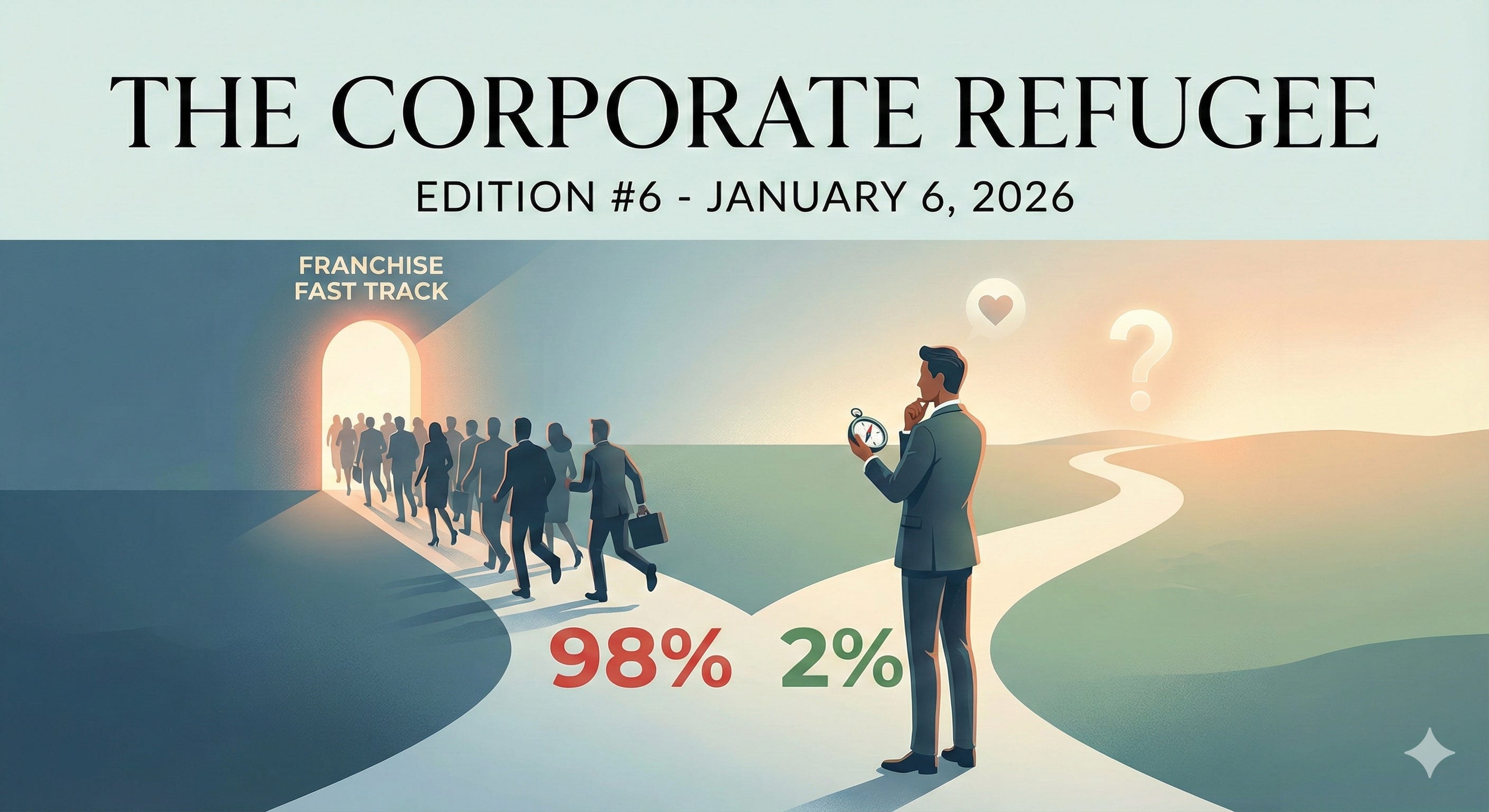
There’s a quiet statistic that few people talk about.
For every 100 people who raise their hands and say,
“I think I want to own a business,”
Only about two actually move forward.
Ninety-eight don’t.
Not because they’re lazy.
Not because they’re incapable.
Not because they lack ambition.
But because somewhere along the way, something didn’t fit.
And many of them walk away believing that means they failed.
The story we’re told
If you spend any time around entrepreneurship—especially franchising—you start to absorb a familiar narrative:
Decisive people win.
Indecision is fear.
Momentum matters more than timing.
If you don’t move, someone else will.
So when you don’t move forward—when weeks turn into months and clarity doesn’t magically arrive—it’s easy to assume something is wrong with you.
But what if the opposite is true?
What the funnel doesn’t show you
Here’s what most people never see:
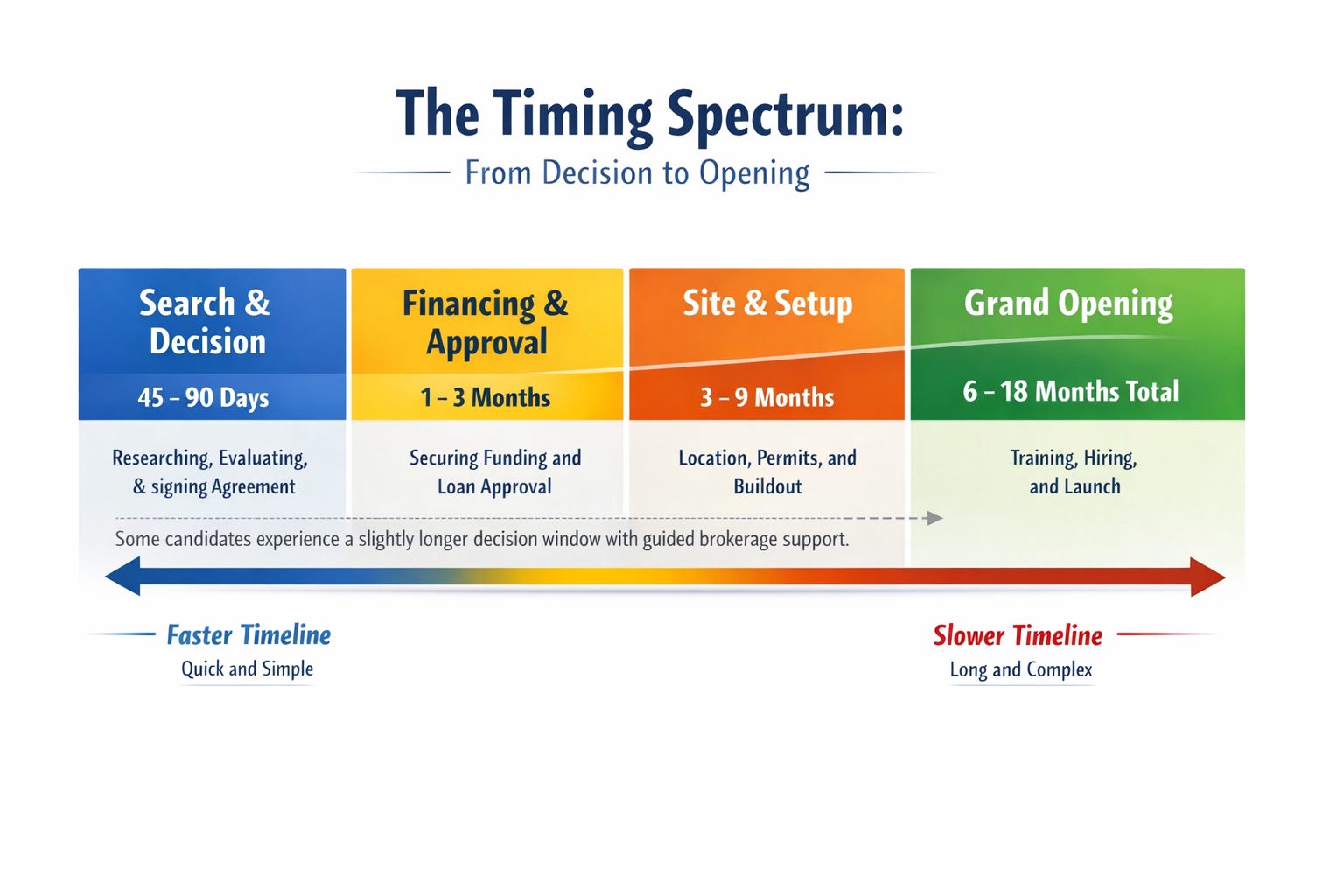
The franchise world is built around compressed decision windows.
You’re expected to:
Explore a life-altering decision in 45–90 days
Commit capital
Choose a path
Say yes with confidence
Why the rush?
It’s rarely about the business opportunity expiring.
It’s about the sales cycle.
Franchise development teams operate on monthly quotas and quarterly targets. When someone urges you to “decide in 60 days,” they aren’t calibrating to your life—they’re calibrating to their fiscal calendar.
And then—after you sign—you may wait 6 to 18 months just to open your doors.
Think about that for a moment.
Fast decisions.
Slow consequences.
It’s not that people can’t decide.
It’s that the pace of the decision often doesn’t match the pace of real life.
A subtle difference in timing (that most people don’t realize)
You might also notice something subtle if you compare paths.
Candidates who work with franchise brokers or consultants often experience a slightly longer decision window—sometimes an additional 30 days—because early education, filtering, and pacing happen before brands are formally introduced.
For some people, that buffer is genuinely helpful.
It reduces early pressure and creates space to ask better questions.
But that extra time comes with a tradeoff.
When someone else curates the options, the window may be longer—but the lens is narrower. You gain breathing room, but you also inherit the assumptions, incentives, and preferences of the person guiding you.
Neither path is right nor wrong.
What matters is knowing which tradeoff you’re making—and whether it aligns with how you decide.
The people who don’t move forward aren’t failing
Most people who exit the process don’t do so loudly.
They don’t rage-quit.
They don’t make dramatic announcements.
They quietly step back.
They say things like:
“Now might not be the right time.”
“I just need to think a bit more.”
“I’m not sure this fits anymore.”
And then they carry that hesitation like a private flaw.
But here’s what I’ve learned—both personally and through years of conversations:
Many of the people who don’t move forward are the most thoughtful ones in the room.
They’re not chasing certainty.
They’re searching for alignment.
The guidance gap no one names
There’s another layer most people don’t realize until much later:
Very few candidates intentionally choose their guidance.
They don’t select an advisor based on values, pace, or philosophy.
They simply talk to whoever responds first.
From that moment on, the lens through which they see the entire franchise world is shaped—quietly, unintentionally, but powerfully.
This doesn’t make advisors bad.
It makes the system incomplete.
When guidance moves faster than self-understanding, people feel pressure where they need clarity.
And clarity doesn’t come from more options.
It comes from better questions.
The overlooked middle
There’s a large, invisible group that rarely gets named.
People who are:
Too thoughtful to rush
Too honest to fake confidence
Too values-driven to force a fit
They don’t need more brands.
They need orientation.
They need permission to slow down without drifting.
They need transparency instead of urgency.
They need guidance that respects timing as much as outcomes.
And when they don’t find that?
They quietly disappear from the funnel—and assume the exit was a personal failure.
It wasn’t.
A reframe worth holding onto
If you explored franchising and didn’t move forward, consider this possibility:
You didn’t fail the process.
The process simply wasn’t designed for how you decide.
Especially if:
Purpose matters to you
You care about impact, fairness, and meaning
You want to understand the why, not just the what
You’re allergic to being manipulated or rushed
Hesitation, in that case, isn’t weakness.
It’s discernment.
Where this leaves us
I’m not writing this to convince anyone to buy a franchise.
I’m writing it to name something quietly true:
The 98 who don’t move forward aren’t failures.
They’re the ones who start consultancies.
They’re the ones who buy established businesses instead of startups.
They’re the ones who decide—for now—that their W-2 job actually funds a life they love.
They chose reality over the fantasy of ownership.
You may simply be someone who refuses to perform certainty before it’s earned.
And in a world that rewards speed, that’s a quiet act of integrity.
If you’re looking for orientation (not pressure)
If any of this resonates, and you find yourself wanting a bit more clarity—not about what to choose, but about how you decide—I’ve built a quiet starting place for that.
It’s a short reflection tool hosted through the assessment portal we use for FranchiseFitGuide.
The purpose isn’t to push you toward franchising.
It’s not to tell you what to do next.
It’s simply to help you understand:
How you operate
What you value
What kinds of business environments tend to fit you best
It also creates clearer conversations later—because in franchising, fit works both ways.
There’s no obligation.
No follow-up pressure.
No “right” result.
Just orientation, if and when it’s helpful:
More soon,
—Chris