When Mission Becomes a System
What Erin Fletter’s Sticky Fingers Cooking story reveals about the difference between a meaningful idea and a durable business.

Some businesses attract attention because their mission is beautiful. Very few become durable because their system is strong.
This distinction is easy to miss. When we encounter a business doing meaningful work—helping children, improving communities, empowering entrepreneurs, expanding access to education—we naturally assume the mission itself will carry the organization forward.
But mission alone does not create durability. Structure does.
The moment when a mission becomes operational—when an idea turns into a repeatable system—is where many ventures either begin to scale or quietly stall. Recently on the Corporate Refugee podcast, I spoke with Erin Fletter, founder and CEO of Sticky Fingers Cooking. Her story offers a clear window into this transition.
It is not a transition from mission to profit, but from mission to system.
The Quiet Shift Many Professionals Feel
Many of the people drawn to meaningful work are professionals who have spent years operating inside corporate systems. They understand structure, processes, and how organizations function. But somewhere along the way, many begin to feel a quiet shift.
Nothing is broken.
The career still works.
The paycheck still clears.
The organization still functions.
But the structure that once felt supportive begins to feel limiting. Not because the work itself has lost meaning, but because something deeper begins to change: the professional realizes they do not necessarily want to stop working. They want to start owning the system they operate inside.
That moment is what I often call the beginning of the Corporate Refugee journey. And it is why stories like Erin’s resonate so strongly.
The Kitchen Table Origin
Sticky Fingers Cooking began the way many meaningful ideas do: at a kitchen table.
In 2011, Erin started the business with $5,000 and a simple belief: kids should learn how to cook. Not just cupcakes or macaroni and cheese, but real food—global flavors, unfamiliar ingredients, and hands-on learning experiences. The concept resonated quickly. Children were curious, parents were grateful, and communities responded.
But early enthusiasm is not the same as durability. Many ideas that inspire people never become businesses that survive because inspiration alone cannot carry operational weight.
Eventually, every founder encounters a deeper question: Can this idea become a system someone else can run? That question quietly sits beneath every entrepreneurial story.
Mission Attracts People. Systems Carry the Weight.
It is common to hear founders talk about vision. What is less commonly discussed is the discipline required to operationalize that vision. During our conversation, Erin described her leadership role this way:
“My job is to paint a vision with one hand and build systems with the other.”
That sentence captures the central tension of entrepreneurship. Vision attracts people; systems sustain them. Without vision, organizations stagnate. Without systems, they collapse.
Most founders instinctively lean toward one side or the other. Some are visionaries who struggle with operational structure, while others are operators who lack a compelling narrative. The rare businesses that scale are those where the two become inseparable.
Sticky Fingers Cooking eventually reached that point. Not because the mission changed, but because the structure behind the mission matured.
The System Behind the System
One idea I return to often when studying durable businesses is something I call the system behind the system. Most people look at a business and see only the visible elements: the brand, the storefront, the product, and the marketing.
But durable businesses are rarely built on those visible layers. They are built on the invisible architecture underneath them:
Hiring systems
Training systems
Operational playbooks
Decision frameworks
This is the structure that allows the business to function without constant founder intervention. When that architecture becomes strong enough, ownership changes. The business stops behaving like a personal project and becomes something other people can step into.
That shift is where scalability—and eventually franchising—becomes possible.
The Constraint That Became the Advantage
One of the most interesting aspects of Sticky Fingers Cooking is something that initially appears to be a limitation: there are no traditional classrooms, no permanent kitchens, and no brick-and-mortar locations.
Instead, instructors bring portable cooking kits directly into schools, libraries, community centers, and camps. At first glance, this might look unconventional. Operationally, however, it creates extraordinary leverage.
No long-term leases.
No expensive build-outs.
No idle real estate.
The system travels to where the community already exists. The business did not scale because it looked impressive; it scaled because the structure was simple and repeatable. Many ventures struggle because complexity grows as they expand. This one became simpler.
When Franchising Entered the Picture
By the time the pandemic arrived, Sticky Fingers Cooking had already expanded organically into multiple states. The curriculum library existed, the training processes were established, and the operational playbook was clear. The system worked.
But a surprising realization shifted Erin’s thinking about the next phase of growth. During the pandemic, she began researching statistics about female entrepreneurship and discovered something striking: Women represent roughly half the population in the United States, yet fewer than 2% of female-owned businesses surpass $1 million in annual revenue.
That statistic reframed the opportunity. Franchising was no longer simply a growth mechanism for the brand; it became a vehicle for creating more women business owners. Sticky Fingers Cooking was no longer only about teaching kids to cook—it was about enabling entrepreneurs to build businesses of their own.
But this only works if the system works. Once a founder invites other people into ownership, the structure must be strong enough to support operators beyond the founder. This is where many franchise concepts struggle: they replicate the brand, but they cannot replicate the system.
Why Corporate Professionals Often Thrive in Franchising
One observation Erin shared stood out: many of her most successful franchise owners previously worked in corporate environments.
That may surprise people who think of franchising primarily as an escape from corporate life, but the explanation is straightforward. Corporate environments train people to operate inside systems. These professionals already understand processes, communication, leadership structure, and accountability.
When those individuals transition into ownership—particularly within a well-designed franchise system—the learning curve can be surprisingly short. The structure feels familiar. The difference is that now, they own the outcome.
For many professionals, that shift is transformational. The systems they once operated inside become systems they now control.
When Systems Become Quiet Infrastructure
Today, Sticky Fingers Cooking classes take place across schools and community organizations throughout the country. Thousands of children participate each week, cooking dishes their parents might never expect them to try: black bean burgers, scallion pancakes, and global recipes from cultures they may have never encountered before.
But the deeper impact is not only culinary. The business has become embedded in the communities it serves. Schools depend on the enrichment programs. Families trust the experience. Local entrepreneurs run the territories.
Something interesting happens when a business reaches this stage: It stops behaving like a brand and starts behaving like infrastructure. The system becomes part of the local economic ecosystem. That is when ownership becomes durable. Not because the founder works harder, but because the structure becomes strong enough to support others.
Many of the most stable businesses in the real economy follow this quiet pattern. They rarely dominate headlines. They rarely raise venture capital. But they compound steadily over time. One system. Then another. Then another.
Eventually, a network of systems begins to form. What emerges is something I often describe as a quiet empire. Not an empire of hype, but an empire of durable ownership.
And almost always, it begins the same way: with a meaningful idea that eventually becomes a system.
The Ecosystem Lens
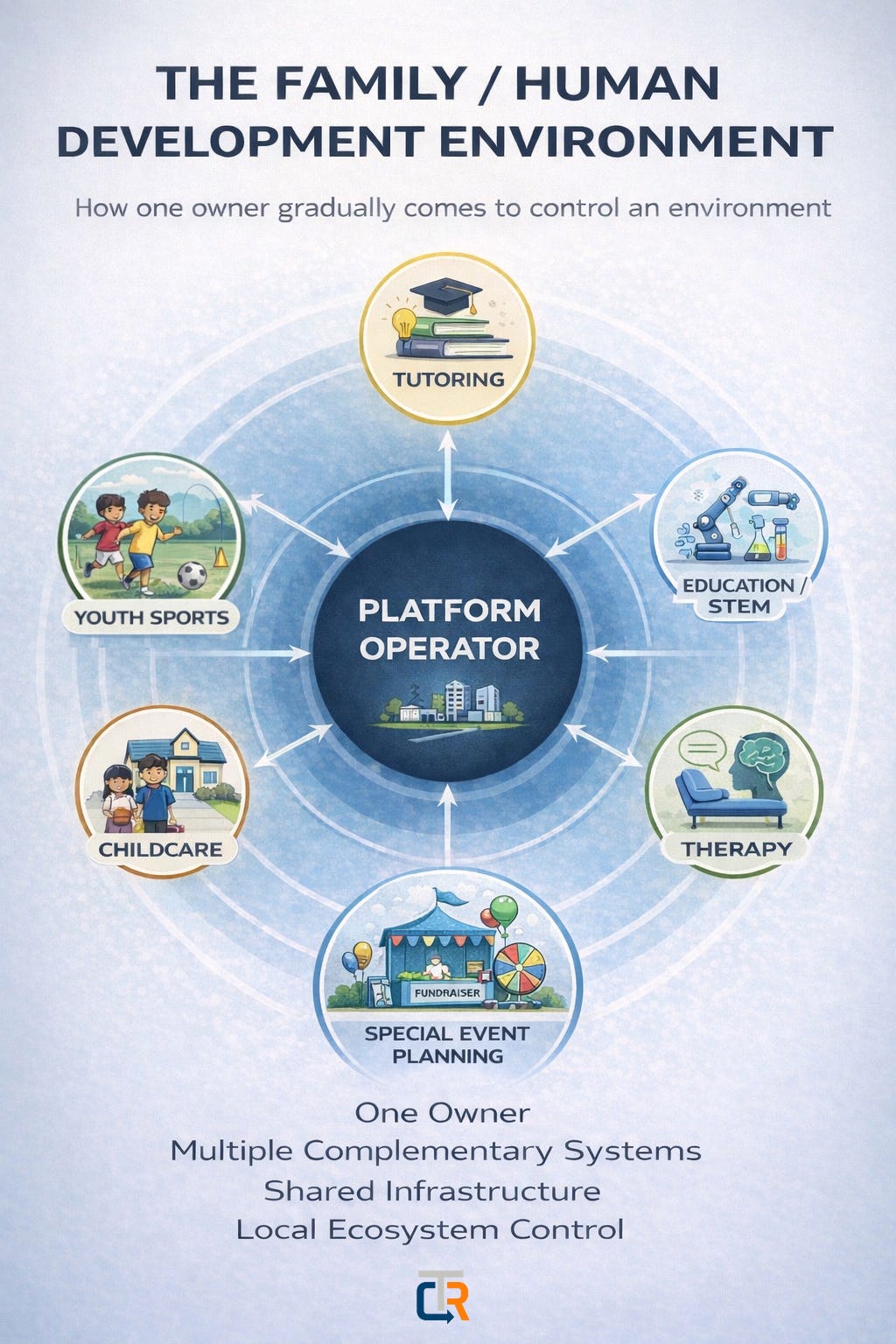
One of the ideas I explore often is that businesses rarely exist in isolation. They operate inside ecosystems—networks of services that naturally surround the same customer, community, or life stage.
When you start to look at the world this way, industries become less important than environments. Families raising children, for example, do not interact with just one service. They move through an entire ecosystem of programs that support learning, development, activity, and growth.
Sticky Fingers Cooking sits inside what we might call the Youth Enrichment ecosystem. Within that environment, families often interact with multiple complementary systems, such as:
STEM education programs
Youth sports enrichment
Tutoring programs
Arts and creativity programs
After-school programs and camps
For operators thinking about long-term ownership, an important question naturally emerges: What additional systems reinforce the same ecosystem?
When businesses share the same customers, relationships, schedules, and community infrastructure, they begin to reinforce one another. This is where durable ownership begins to take shape. Not through a single business, but through aligned systems operating inside the same environment.
Over time, those systems share relationships, resources, and infrastructure—strengthening the entire platform.
Are you ready to evaluate your FitFirst Operating Profile? Two paths forward: Guided advisory or structured, independent evaluation.
Begin here: https://zorakle.net/assessment-portal/welcome/the-corporate-refugee