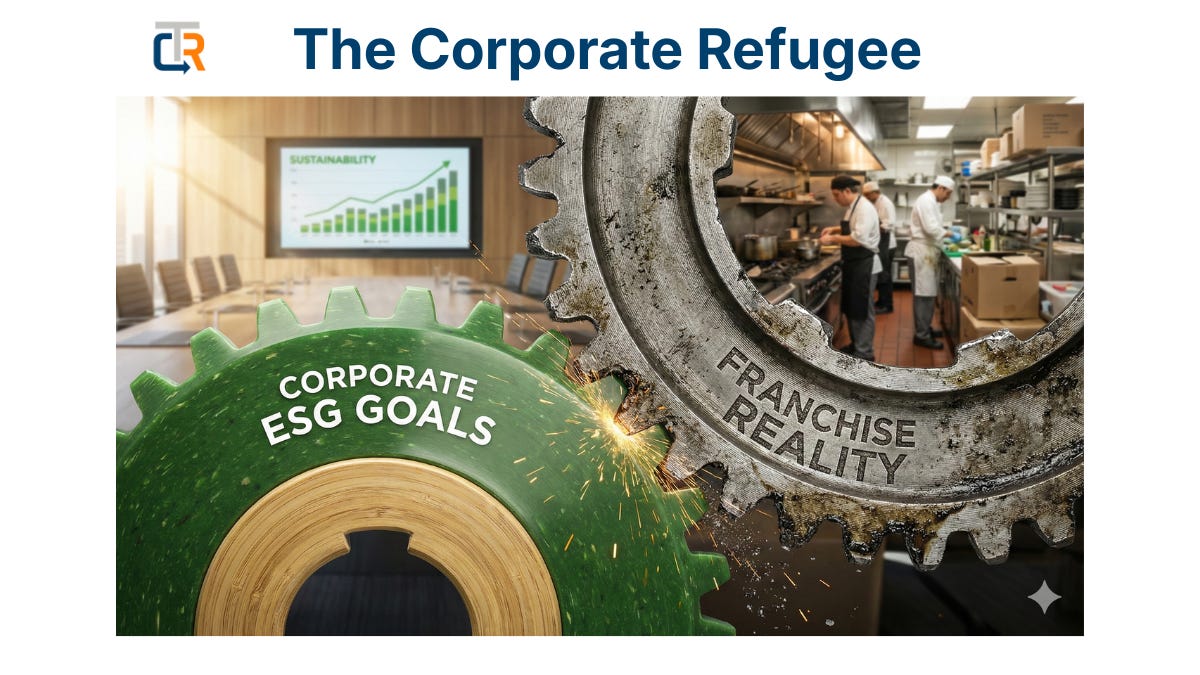
When Corporate ESG Meets Franchise Reality
The operational friction hidden beneath corporate sustainability goals.

Edition #11
With the lead-up to Valentine’s Day, for grand commitments and public declarations. Corporate sustainability announcements can feel similar. The real test, however, isn’t the promise. It’s the follow-through.
Consider the moment a national retail chain announces a bold sustainability initiative.
50% emissions reduction. 50% food waste reduction. Sustainable packaging mandates. “Health-forward” product shifts.
The slide deck is beautiful. The logic is sound. The press release is already written.
But before we applaud the ambition, we need to slow down.
We need to look at ESG (Environmental, Social, and Governance) not as a strategy, but as an operational reality.
At the corporate level, ESG is a positioning tool. It manages risk, attracts investors, and signals virtue. At the franchise level, it is execution.
And that is where the friction begins.
The Two Realities
There is a fundamental disconnect between how a brand is managed and how a store is run.
Corporate leadership thinks in:
Carbon reporting
Long-term brand equity
Investor relations
National supply chain resilience
Franchise owners think in:
Shrink
Labor variance
Gross margins
Inventory velocity
Daily execution
Both viewpoints are rational. But they operate in different time zones.
Corporate is solving for the next decade. The franchisee is solving for the next shift.
The Translation Gap
This disconnect creates a “translation gap” where strategic intent morphs into operational chaos.
When corporate announces:
“We’re reducing food waste by 50%.”
The franchisee hears:
“Is this going to increase my spoilage variance? Who pays for the miss?”
When corporate says:
“We’re prioritizing fresh, local sourcing.”
The franchisee hears:
“Is this going to complicate my ordering cadence? Do I now manage three vendors instead of one?”
When corporate says:
“We’re pushing healthier grab-and-go options.”
The franchisee asks:
“What is the shelf life? How fast will it turn? And where does it go when it doesn’t?”
This isn’t resistance. It’s survival.
Franchise systems are optimized for consistency, speed, and efficiency. You cannot casually inject complexity into them without breaking the rhythm that makes them profitable.
Good Intentions vs. Bad Unit Economics
Fresh product is often the flashpoint.
It aligns beautifully with sustainability goals. It matches evolving consumer demand. But operationally, “fresh” is expensive.
It introduces:
Shorter shelf life
Greater shrink risk
More handling labor
More operational friction
Good intentions do not override bad unit economics.
If a sustainability initiative increases waste or labor at the store level, it will quietly die—regardless of how well it photographs for the annual report.
What Actually Scales
For ESG to work inside a franchise system, it must do more than align with values.
It must:
Reduce friction (not just add steps)
Protect margins (or offer a clear ROI)
Simplify execution (remove a task for every new one added)
Be replicable (without requiring heroics from the manager)
If a system requires enthusiasm to sustain, it won’t scale. Enthusiasm has a half-life. Systems do not.
The Missing Layer
What most organizations underestimate is the “translation layer.”
Corporate strategy rarely fails because it is misguided. It fails because no one engineered it for unit-level reality.
Sustainability at scale requires infrastructure, not inspiration.
The franchisee doesn’t need a mission statement. They need:
Predictability
Simplicity
Clarity
Operational leverage
The Litmus Test for Freedom
For the Corporate Refugee, this is more than just an operational headache. It is a litmus test for the asset you are buying.
We seek Freedom Through Proven Systems.
But a system is not “proven” just because it has a brand name or a mission statement. It is proven that it can handle complexity without breaking the operator.
If you buy into a system that hasn’t solved the translation gap—where corporate ambition is just dumped onto store-level labor—you aren’t buying freedom. You are buying the friction that they couldn’t figure out how to automate.
True freedom requires a system where the “good” is engineered into the “profitable.” Anything less is just a job with a mortgage.
A Question Worth Sitting With
Whenever you see a bold corporate commitment, ask:
Who operationalizes this?
Who absorbs the friction?
Who carries the financial risk?
Has the translation been engineered?
Because when Corporate ESG meets Franchise Reality, the slide deck doesn’t matter anymore. That is where the truth of the system is revealed.
The systems that survive the next decade won’t be the ones with the loudest commitments. They will be the ones who reconcile vision with execution.
Quietly. Structurally. Predictably.