The Translation Layer
How Mary Wetherill & Green Food Solutions Turned Purpose Into a Paid Contract

Edition #12
Corporate sustainability announcements are easy to applaud.
A beautiful slide deck. A bold target. A clean narrative.
But last week I wrote about at the corporate level, ESG is positioning. While at the franchise level, ESG is execution.
And execution lives in the harshest place in business:
Labor variance.
Shrink.
Gross margin.
The next shift.
Good intentions don’t override bad unit economics. If a mission adds friction, it quietly dies.
Which brings me to Mary Wetherill.
Mary didn’t just build a purpose-driven business. She built the missing piece that most “impact” initiatives never solve:
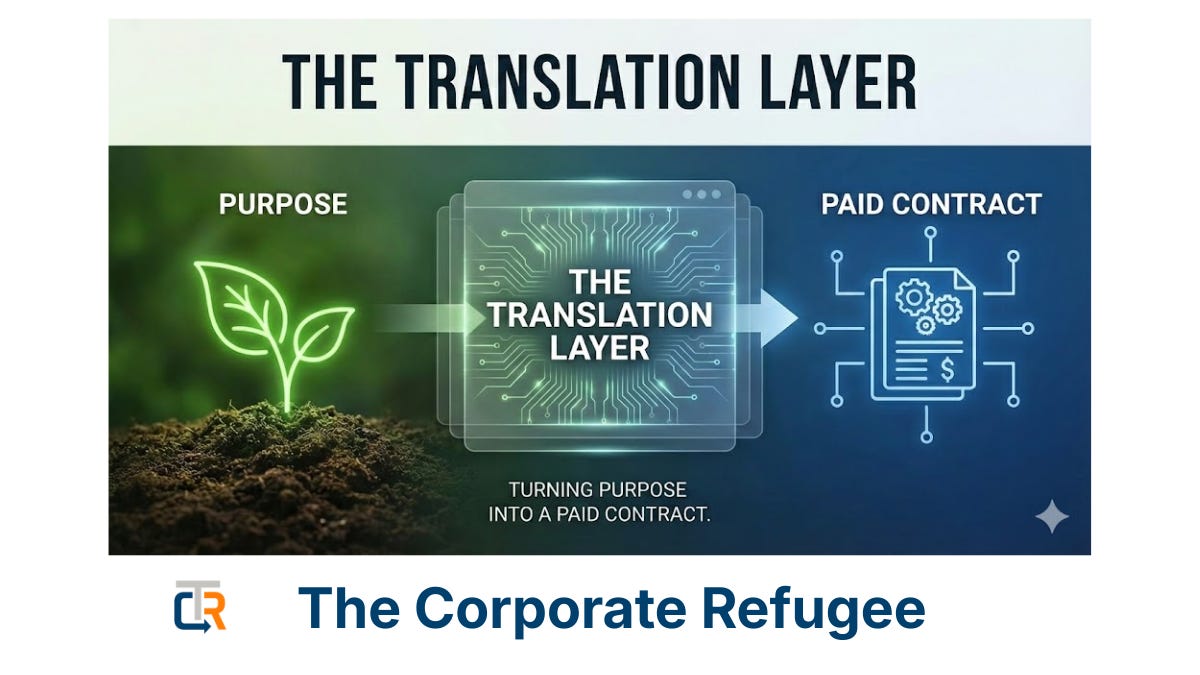
A translation layer. The mechanism that converts values into something the market will reliably buy, renew, and operate without breaking the system.
The Mission vs. The Model
Mary and her team were trying to make commercial urban farming work during the vertical farming boom. You probably remember that era: Hydroponics. Shipping containers. Giant greenhouses. Venture money. Big promises.
But the economics were brutal.
Farming, as Mary put it, is like restaurants: high capital costs + low margins.
And when a business model is structurally fragile, it doesn’t matter how “right” the mission is. The system collapses under the weight of its own effort.
That’s what makes Mary’s story so useful for Corporate Refugees. Because the moment she stopped trying to win the old game, she didn’t quit.
She redesigned the rules.
The Pivot: From “Farm” to “Amenity”
Mary came from the service world—massage therapy, wellness, corporate office services. So while she was on a rooftop greenhouse in the Bronx, one detail hit her like a flashing warning light:
They were growing food… and none of it was going to the people who lived in the building.
That’s not just a social issue. That’s a signal.
A system was absorbing effort without delivering value to the immediate environment. So she asked a different question:
What if the customer isn’t the lettuce buyer?
What if the customer is the building?
That’s the pivot.
Mary didn’t build a farm business. She built an amenity business.
“Amenity” is a language developers already understand. They buy amenities to rent units faster, sell at a premium, differentiate in a crowded market, and support ESG/LEED narratives with proof.
Most purpose-led founders try to convince the market to care. Mary did something more durable: She found the existing buyer logic and attached the mission to it.
That’s the translation layer.
The Durability Stack (Why This Scales)
When I talk to founders and franchisors, I’m always listening for one thing: Does the model protect the operator?
Mary’s does—because it was engineered for repeatable execution. Here’s the stack:
1. The buyer already buys the category “A farm”, which can sound like a passion project. “An amenity” sounds like a line item. Same physical output. Completely different decision frame.
2. High-ticket B2B contracts (not volume retail). This isn’t “sell more units to survive.” This is “close fewer, bigger deals.” Mary described average service tickets in the tens of thousands, with a range that makes the model flexible across segments.
3. Annual prepay (cash flow designed in.) This is the quiet killer feature. Customers pay a full year upfront. Not because Mary forced it, but because the value is real enough that the market accepts it. That’s not just a financial detail. It’s structural safety. It lets operators plan labor and service delivery with confidence.
4. Plug-and-play operations (complexity removed.) Mary is blunt about this: You don’t need a green thumb. You don’t need to be a plumber. If you can connect a hose to a spigot, you can learn the system. That’s franchise language. Repeatable outcomes through a teachable process.
5. Retention logic that behaves like a “pool.” Once a building invests in the farm systems, they don’t rip them out. The switching cost isn’t just money—it’s differentiation. That’s how recurring revenue becomes durable. Not because the founder “cares more,” but because the system makes staying on the path of least resistance.
The Corporate Refugee Lens
Most people who feel “pulled” toward purpose-driven work assume the leap is emotional: Quit the job. Follow the calling. Be brave.
But the hard part isn’t courage. The hard part is engineering.
Corporate Refugees don’t need more inspiration. They need a model that holds up on a Tuesday.
Mary built that. She took a mission that could have stayed a fragile ideal—food access, affordability, justice—and she designed it into a business the market can sustain.
Not by moralizing. By translating.
A Question Worth Sitting With
If you’re feeling pulled toward purpose-driven work, here’s the question Mary’s story forces:
What version of your mission are you still attached to—even though the economics are telling you it won’t survive?
And the follow-up:
What would the “amenity” version of your mission be? The version the market already understands, buys, renews, and can execute without breaking the operator.
That isn’t selling out. That is building something that lasts.
Because purpose doesn’t scale. Systems do.
🎙️ Episode Note
This week’s episode with Mary Wetherill (Green Food Solutions) goes deeper on the pivot, the annual prepay model, the “no national competitors” category advantage, and why franchising became the mission-aligned scale path.
If you’ve ever wondered what it looks like when purpose becomes a proven system—this is the case study.
And if you’re building inside a system that no longer fits: Don’t just leave. Translate. Redesign. Build the layer.
Freedom follows structure.