The Infrastructure Era of Franchising
Why the next generation of franchise systems may power communities rather than storefronts

The Systems Ownership Framework
1️⃣ Terrain
2️⃣ Driver
3️⃣ Architecture
4️⃣ Ecosystems
5️⃣ Ownership Flywheel
6️⃣ The Quiet Empire
This essay is the first in a six-part series exploring franchising through a different lens. Most conversations about franchising focus on brands, but this series focuses on systems. Over the next several essays, we’ll examine questions that shape durable ownership, like: where durable systems exist (Terrain), who is wired to operate them (Driver), and how ownership compounds over time (Architecture).
When most professionals begin exploring franchising, they usually picture the same kinds of businesses: restaurants, boutique gyms, and retail storefronts. In other words, consumer brands. Those businesses dominate the public perception of franchising because they are the most visible, with storefronts sitting on busy streets and brands that advertise directly to consumers.
But quietly, something else is happening inside the franchise industry. A small but growing number of systems are beginning to look less like consumer brands—and more like local infrastructure.
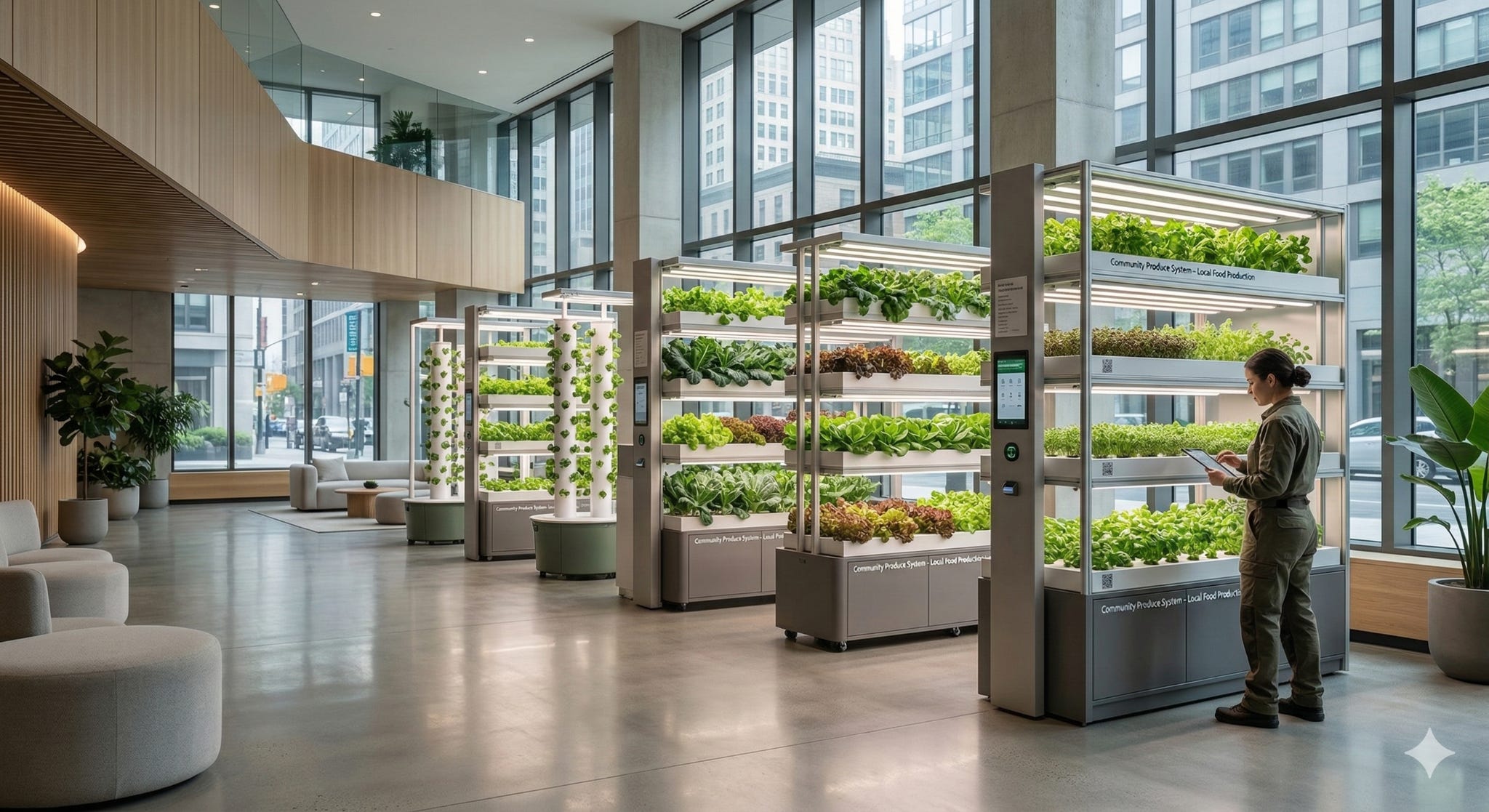
Not long ago, I had the opportunity to visit the headquarters of an emerging franchise operating in the controlled-environment agriculture space. Instead of walking me through a pitch deck in a boardroom, the leadership team invited me to see the system operating in real time. Their corporate office was located inside a coworking space, but just outside the building was something far more interesting: a fully functioning vertical farm.
Rows of leafy greens were growing in a carefully controlled environment and nourished by precisely regulated water and nutrient flows. After showing me the system, the CEO walked me to several nearby locations where their technology and weekly service were installed inside mixed-use residential developments. They are also in municipal buildings, universities, hospitals, and corporate campuses. These weren’t experimental prototypes; they were live production systems operating inside communities, producing fresh food directly inside the properties where people lived.
What struck me most was the business model. Most people assume vertical farming would operate like a consumer business—a retail farm stand, a produce subscription service, or a direct-to-consumer brand. This system worked very differently, structured as a B2B model. The customers were not the residents; they were the property owners and building operators. Those buildings purchased the vertical farming equipment and paid an ongoing service contract for the system’s operation and maintenance, while residents simply received the benefit of fresh produce grown inside their own building.
In other words, the system wasn’t selling vegetables—it was providing infrastructure. The franchise operator installs the system, manages the production environment, and maintains the operating protocols that keep it running. Revenue comes from the equipment installation and the recurring weekly service relationship with the property owner. There is no storefront, no reliance on foot traffic, and no consumer marketing. At first glance, it didn’t even feel like franchising; it felt like distributed infrastructure.
That realization stayed with me long after the visit. Years earlier, I had experienced the other side of the spectrum. I had owned a boutique wellness franchise during the height of that category’s popularity. The brand was strong, the community was enthusiastic, and the growth narrative was compelling. For a time, the model worked well. But like many consumer-driven concepts, the category eventually saturated, competition intensified, margins tightened, and the excitement that had fueled the expansion began to fade.
I owned the business for about five years before exiting. The experience taught me an important lesson: not every successful franchise system is built on durable foundations. Some are simply built on momentum. That realization led me to rethink how franchise systems should be evaluated. Instead of asking which brand is hottest, it may be more useful to ask a deeper question: What economic role does the system actually play?
The Franchise Infrastructure Pyramid
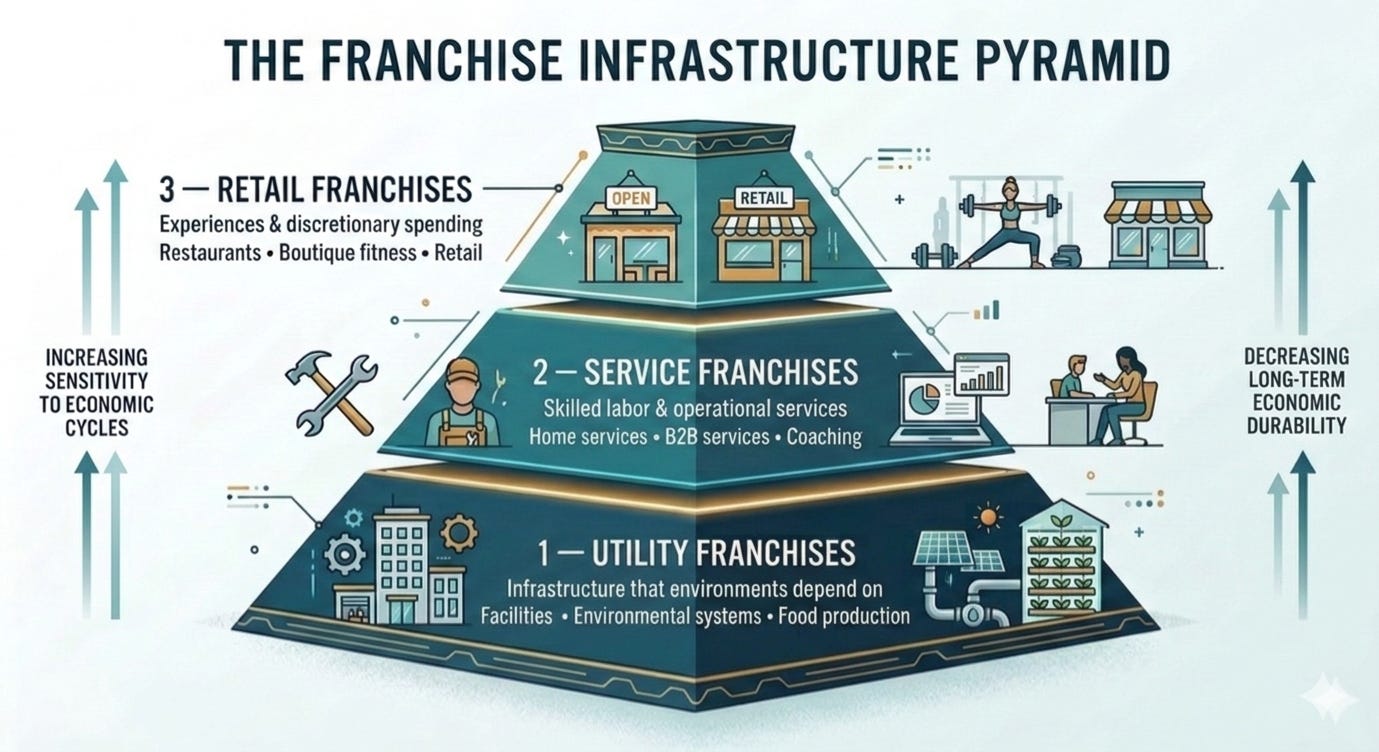
One way to think about franchising is as a pyramid of economic durability. At the top are businesses driven primarily by consumer demand, and at the base are businesses operating closer to essential infrastructure. As you move down the pyramid, the nature of the business—and its long-term resilience—changes significantly.
Layer 3: Retail Franchises (Top of the Pyramid) These are the franchises most people immediately recognize: restaurants, boutique fitness studios, retail stores, and salons. These businesses generate revenue primarily through consumer transactions. They depend heavily on foot traffic, brand perception, marketing effectiveness, and discretionary spending. Retail franchises can perform extremely well when consumer demand is strong, but they are also the most sensitive to economic cycles and changing consumer tastes.
Layer 2: Service Franchises (Middle of the Pyramid) The middle layer contains service-based franchises. These businesses provide ongoing operational work rather than consumer experiences. Examples include home maintenance services, restoration and environmental services, B2B operational systems, and coaching and consulting platforms. These systems depend less on foot traffic and more on relationships and recurring demand. They solve practical operational problems and benefit from what franchising does best: combining centralized systems with local accountability.
Layer 1: Utility & Infrastructure Franchises (Base of the Pyramid). At the base of the pyramid are businesses operating close to economic infrastructure. Examples include environmental systems, energy and water management, controlled-environment agriculture, and production and facilities systems. These businesses often look very different from traditional franchises. There may be no storefront, no consumer brand, and no walk-in customers. Instead, the system revolves around production, maintenance, or operational infrastructure. They rely on standardized environments, repeatable processes, and long-term service relationships. When those systems become replicable, they can be operated locally by entrepreneurs using centralized knowledge and shared infrastructure.
A Structural Shift in Ownership
Several macroeconomic forces are quietly accelerating this shift. Supply chain fragility, climate pressures, urbanization, and technological standardization are pushing many industries toward distributed local systems rather than centralized production. Food is grown closer to cities, energy is generated locally, and environmental systems are managed regionally. When these systems become standardized, they create new opportunities for local ownership powered by shared infrastructure.
A Different Lens for Evaluating Franchising
Most professionals exploring franchising begin by comparing industries like restaurants, fitness, and retail. But a more useful lens may be the economic terrain the system operates within. Is the system built primarily on consumer excitement, operational services, or structural infrastructure?
The further a concept moves toward solving structural needs, the more durable its demand tends to be. But identifying durable terrain is only half the challenge. I’ve seen thoughtful professionals choose strong industries and promising brands—only to discover that the business still didn’t fit the way they were wired to operate. Because business ownership isn’t just about the system you choose; it’s also about the operating system you bring to it.
That question—how the driver interacts with the machine—is where the next part of this conversation begins.
Freedom Through Proven Systems.
Are you ready to evaluate your FitFirst Operating Profile? Two paths forward: Guided advisory or structured, independent evaluation. Begin here:
https://zorakle.net/assessment-portal/welcome/the-corporate-refugee