The Durable Ownership Framework
How thoughtful operators move from business ownership to platform ownership

Most people exploring business ownership start with a simple question:
“Which franchise should I buy?”
It feels like the right place to begin. Find a brand. Validate the model. Move forward. And for many, that works—at least at first. This is what usually happens when franchise candidates go directly to the franchisor.
But over time, a different realization begins to emerge: The long-term outcome isn’t determined by the brand you choose. It’s determined by the system you build.
That distinction is subtle. But it changes everything. Because durable ownership isn’t about participating in a system. It’s about learning how to construct one.
Why This Matters Now
What’s changing is the environment around ownership itself. Trust in large institutions is declining. Economic uncertainty is rising. And more people are beginning to question whether traditional career paths will deliver the outcomes they expected.
As that shift accelerates, ownership is no longer just about income. It’s about control. Stability. And building something that holds up over time.
The Shift Most Franchisees Never Make
Most owners stay inside a single layer of thinking:
Choose a brand
Follow the model
Open additional units
Grow through replication
This is a valid path, but it has a natural ceiling. Because no matter how large the business becomes, it is still dependent on a single operating system.
And that’s where a different path begins to appear. Not just owning units… but building a platform.
The Durable Ownership Framework
Over time, I began to notice that operators who build durable, multi-system ownership platforms tend to move through a similar progression. Not intentionally at first, but structurally.
What this progression looks like in practice is not linear—it’s layered. Most operators never move beyond the early stages. But those who do begin to stack systems in a way that compounds over time.
This is a structural model of how ownership systems evolve. That progression looks like this:
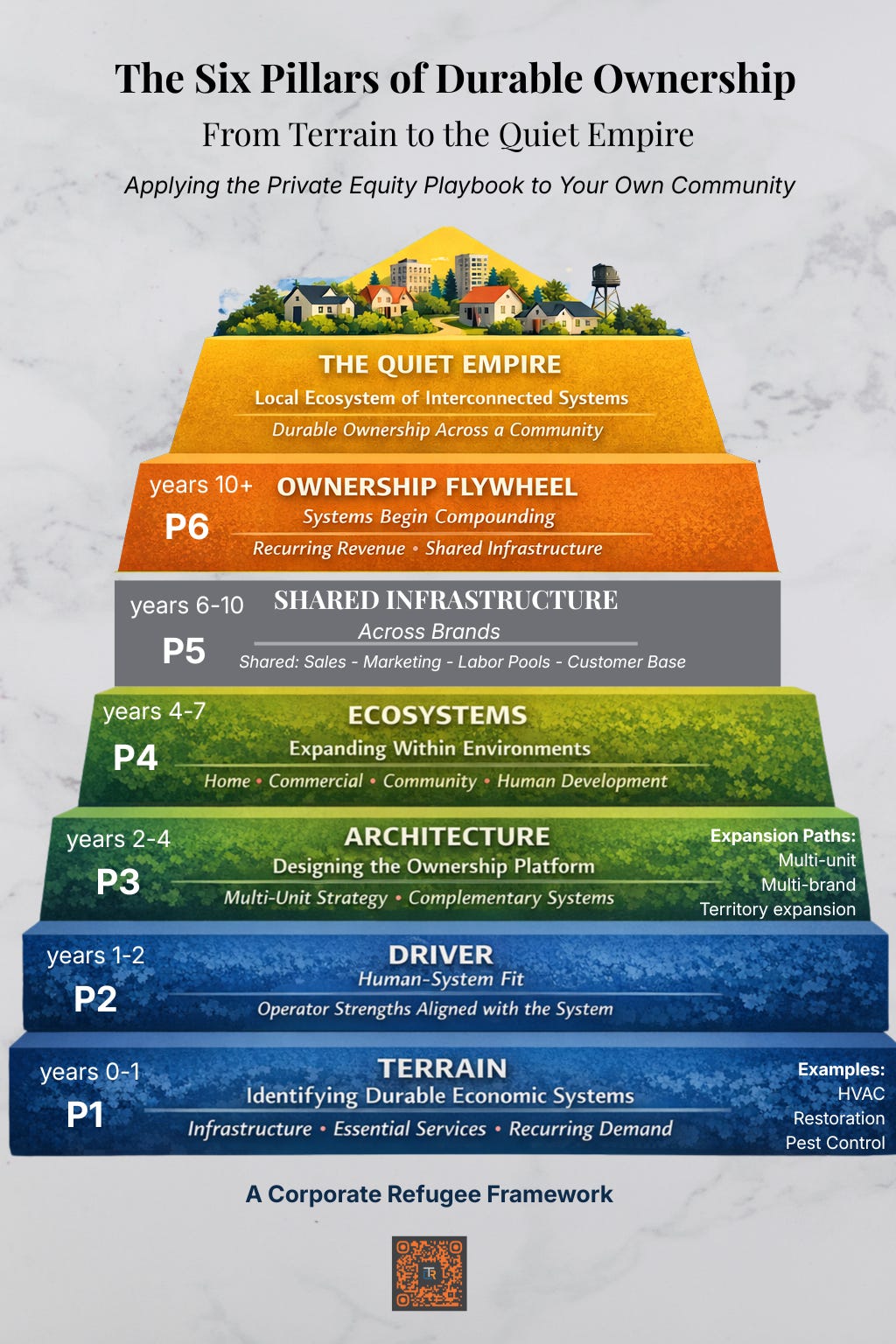
1️⃣ Pillar 1 | Terrain: Identifying durable economic infrastructure
Where you operate determines what is possible.
Before thinking about scale, systems, or ownership structure, a more fundamental question appears: What kind of economic ground is this business sitting on?
Some terrain is built on discretionary spending, foot traffic, constant marketing, and changing consumer behavior. Others operate closer to infrastructure:
Property services
Home services
Environmental systems
Essential care
These businesses are not always glamorous, but they are often more stable, repeatable, and expandable. In a more uncertain economy, this distinction becomes even more important. Businesses tied to discretionary behavior tend to feel volatility first, while infrastructure-aligned services often prove more resilient over time.
The difference isn’t just performance. Its durability. Terrain determines what can compound before the operator ever does.
2️⃣ Pillar 2 | Driver: Ensuring alignment between human and machine OS
Who you are determines what you can sustain.
Once the terrain is clear, the next question is: Am I actually wired to operate well here?
How you make decisions, handle risk, lead people, and operate within structure is not a preference. It’s wiring. Most ownership journeys don’t break because the business is bad. They break because there is misalignment between the operator and the system.
What’s often missing is a clear understanding of the operators themselves. Not interests. Not surface-level preferences. But how they actually operate under pressure and over time. This is where a more deliberate approach becomes necessary—one that evaluates fit before opportunity.
Because even the most durable terrain becomes heavy when the wrong driver is behind the wheel.
3️⃣ Pillar 3 | Architecture: Designing the multi-unit ownership platform
How the business is structured determines how it grows.
At a certain point, effort stops being the constraint. Structure becomes the constraint.
This is where many owners stall, because growth requires systems, delegation, management layers, and a defined operating cadence. Without architecture, growth becomes heavier—not easier. With architecture, the business begins to function as a system, not a job.
4️⃣ Pillar 4 | Ecosystems: Expanding within complementary environments
How businesses relate determines whether they compound.
As operators expand, a new question emerges: Do these businesses actually work together?
Most don’t. But some share overlap in customers, labor, equipment, and operations. When that overlap exists, something changes: The businesses begin to reinforce each other.
This is where ownership starts to shift from expansion… to integration.
5️⃣ Pillar 5 | Shared Infrastructure: Centralizing operations across brands
What is centralized determines efficiency.
As systems begin to connect, certain functions no longer need to be repeated. Hiring, marketing, scheduling, finance, and leadership can be shared.
When these are centralized, the operator is no longer managing multiple businesses. They are managing a platform. At that point, efficiency is no longer the goal. The focus shifts to outcomes—how the system performs, not just how fast it moves.
6️⃣ Pillar 6 | Ownership Flywheel: Systems and capital compounding
How systems reinforce each other determines long-term leverage.
At scale, the system begins to behave differently. Each additional unit or business benefits from existing infrastructure, reduces marginal effort, and increases overall efficiency.
Growth is no longer linear. It becomes compounding.
Why This Matters
Most people never see this progression. They stay focused on brands, industries, and opportunities. But the operators who build durable ownership platforms are thinking differently.
They are asking:
Is this the right terrain?
Am I the right driver for it?
Can this be architected properly?
Will this connect to something larger over time?
A Different Way to Think About Ownership
Business ownership is often presented as a transaction: Buy a business. Run the model. Grow revenue.
But the more accurate lens is this: Ownership is a design problem. The outcome is not determined by effort alone. It is determined by terrain, fit, structure, and integration.
Final Thought
Most people don’t set out to build a platform. They set out to build a business.
But in a world where trust is shifting locally, systems are becoming more interconnected, and outcomes matter more than activity, a different path begins to emerge. The operators who see it early begin to think differently.
Durable ownership isn’t about what you buy. It’s about what you build—and how those pieces fit together.