Start Here: Most People Evaluate Franchises Backwards
The Systems Ownership Manifesto

Start Here: The Systems Ownership Manifesto
How to build durable wealth by moving from consumer brands to local infrastructure.
For decades, the entrepreneurial narrative has been dominated by a single story: the founder story. A visionary creates something from nothing, a startup disrupts an industry, and a brand captures the consumer’s imagination. It is an exciting story, but it is also incomplete.
Most durable wealth in the real economy is not built by inventing entirely new things. It is built by owning and operating systems that communities depend on. Quietly, across cities and towns everywhere, another type of entrepreneur exists. These are not startup founders; they are system operators who own the companies that maintain buildings, service equipment, and keep local economies functioning.
Most conversations about franchising begin with brands. But durable ownership rarely comes from chasing brands. Ownership is fundamentally a systems problem.
The Systems Ownership Framework explores franchising through a deeper lens—one focused on economic durability, human fit, and the compounding nature of operational systems.
Understanding this framework changes how you evaluate business ownership, moving you through six distinct stages of wealth creation.
1️⃣ The Terrain: The Infrastructure Era of Franchising
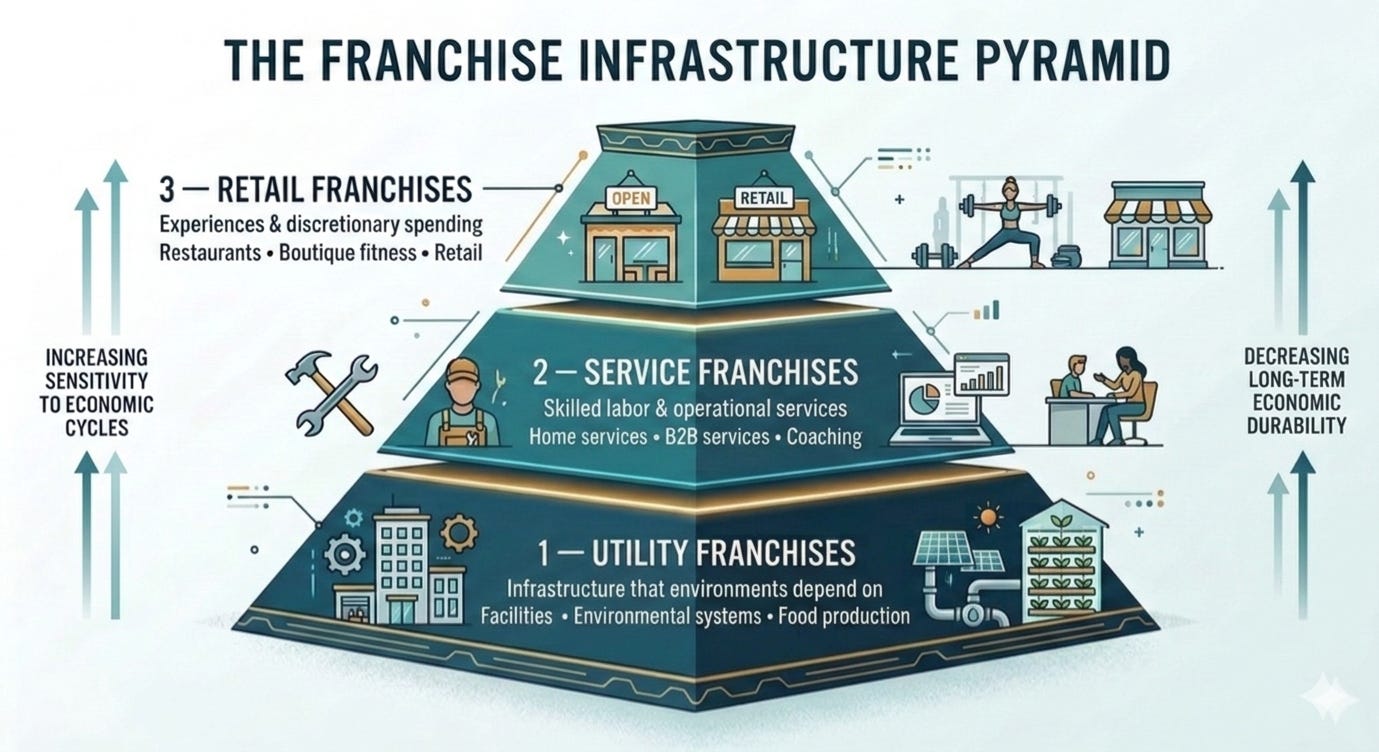
When most professionals begin exploring franchising, they usually picture consumer brands: restaurants, boutique gyms, and retail storefronts. These dominate public perception because they are highly visible.
But quietly, a small but growing number of systems are beginning to look less like consumer brands and more like local infrastructure.
Instead of asking which brand is hottest, ask: What economic role does the system actually play? Think of franchising as a pyramid of economic durability. At the top are retail franchises driven by consumer demand and discretionary spending. At the base are utility and infrastructure franchises—like environmental systems, facilities, and food production—that communities rely on regardless of trends.
The key insight: Durable ownership sits closer to structural needs than consumer trends.
2️⃣ The Driver: The Wrong Vehicle on the Right Road

Choosing the right terrain is important, but terrain alone doesn’t determine success. Capable professionals often choose strong industries and promising brands, only to discover the business feels exhausting to operate. Why? Because the vehicle they chose didn’t match the way they were wired to drive.
Franchising is like stepping into a vehicle that has already been engineered. But modern franchise businesses require the alignment of two operating systems:
The Machine OS: The franchise system itself, running on structured management frameworks, documented processes, and standardized training.
The Driver OS: The internal wiring of the owner. This includes how they make decisions, lead people, manage risk, and approach structure.
The most powerful engine in the world is useless if the driver finds the seat uncomfortable. Success happens when the Driver OS and the Machine OS align.
3️⃣ The Architecture: Don’t Just Buy a Franchise. Build a Platform.
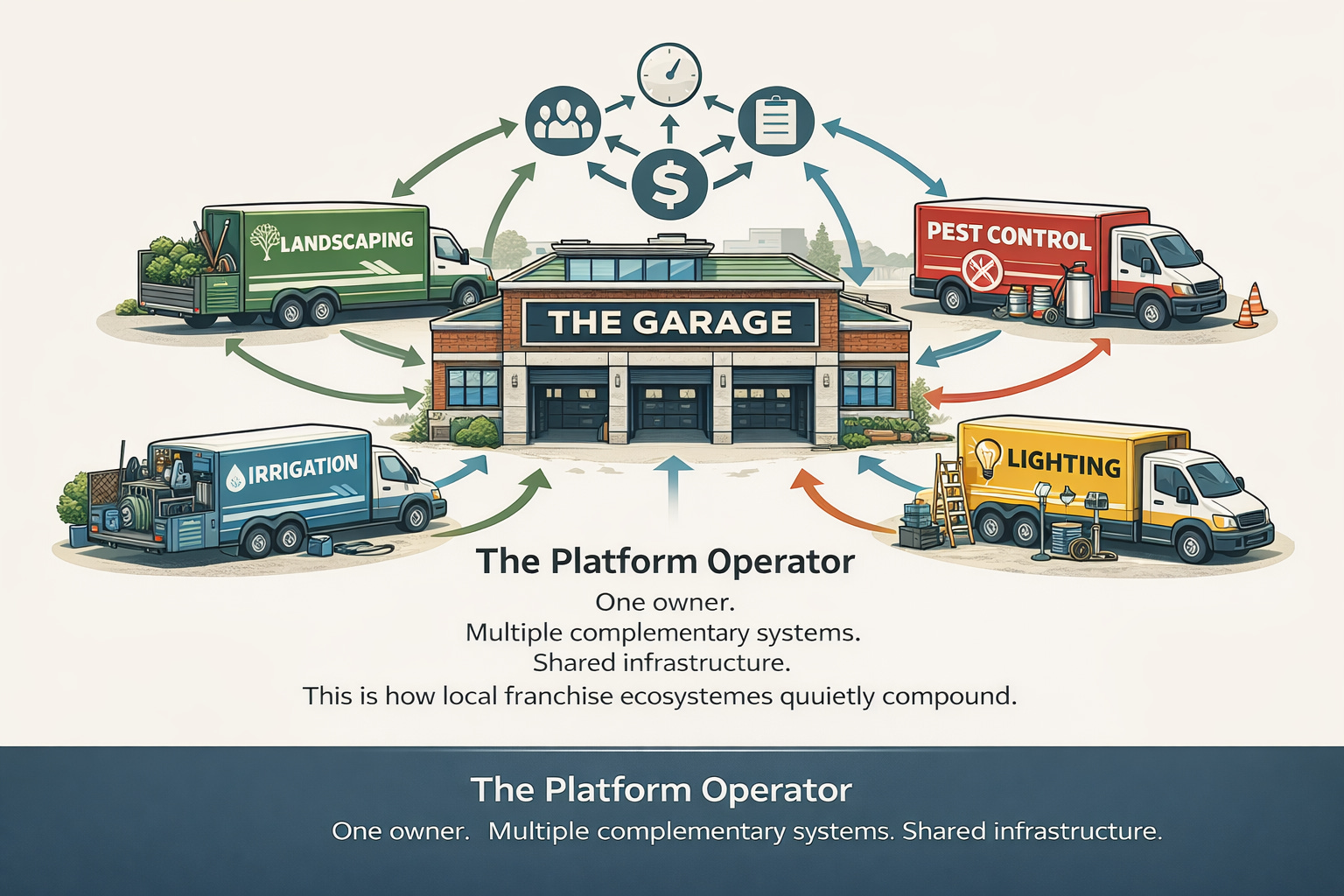
In the early stages of ownership, most entrepreneurs are focused on operating a single system. At this stage, the owner is primarily a driver.
But over time, experienced operators begin to notice patterns: how labor pools overlap and how customer relationships connect across services. The mindset begins to shift. The operator stops thinking about one vehicle and begins thinking about the garage.
They become a Platform Operator, building an operating base capable of supporting multiple complementary systems. Instead of asking, “Which franchise should I buy?” they ask, “What ownership platform am I building?”. They transition from a driver to an architect of systems.
4️⃣ Ecosystems: Platform Compatibility
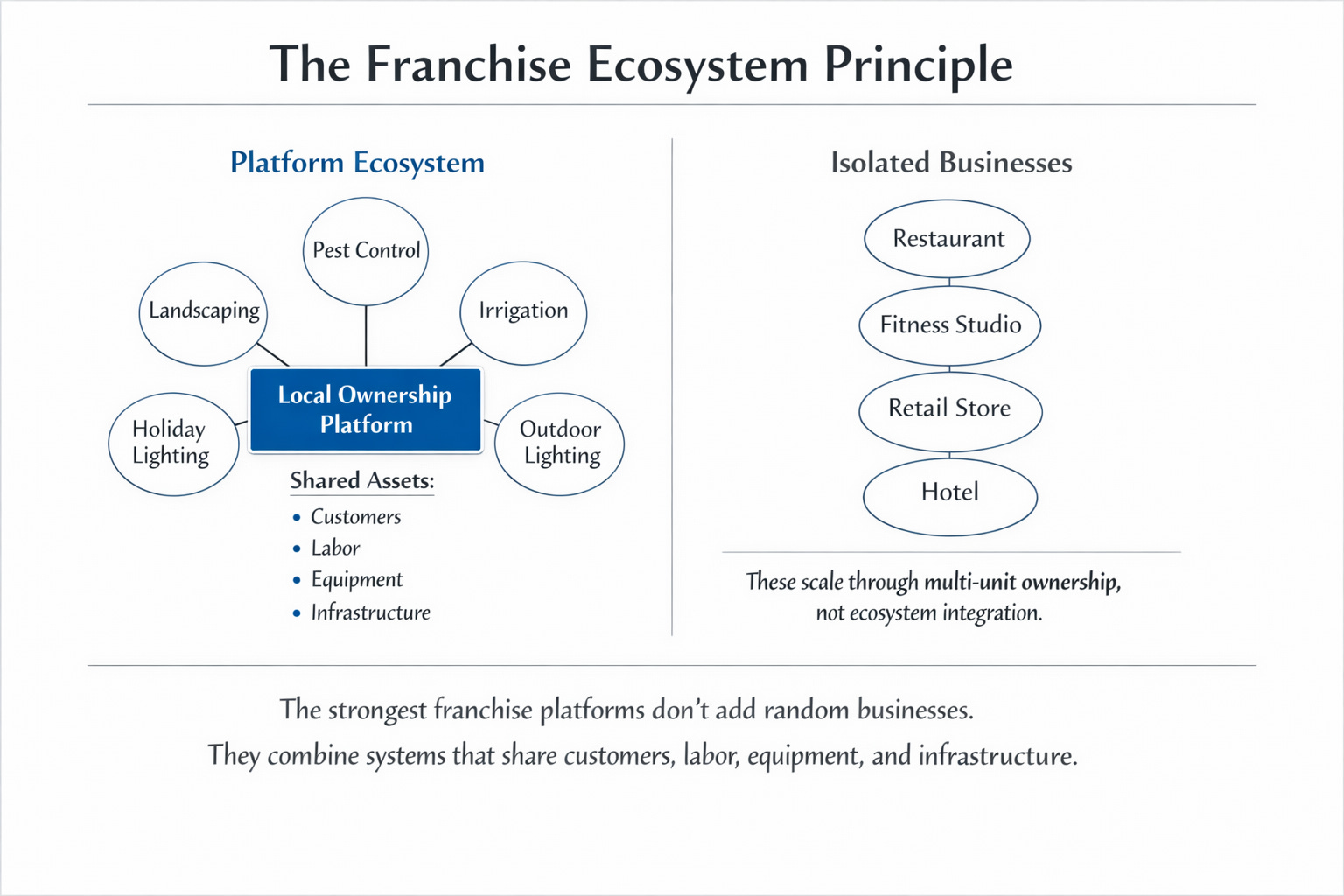
If building complementary systems creates leverage, why doesn’t everyone do it? Because not all systems combine well.
For a platform to work, the systems inside it must share something meaningful: customers, labor pools, equipment, or operational infrastructure.
When these elements overlap, systems reinforce each other. For example, a property services platform might combine landscaping, irrigation, pest control, and outdoor lighting. They share the same homeowners, the same neighborhoods, and often the same trucks. The operator is no longer just evaluating businesses; they are designing ownership platforms within an environment.
5️⃣ The Ownership Flywheel: Compounding Growth
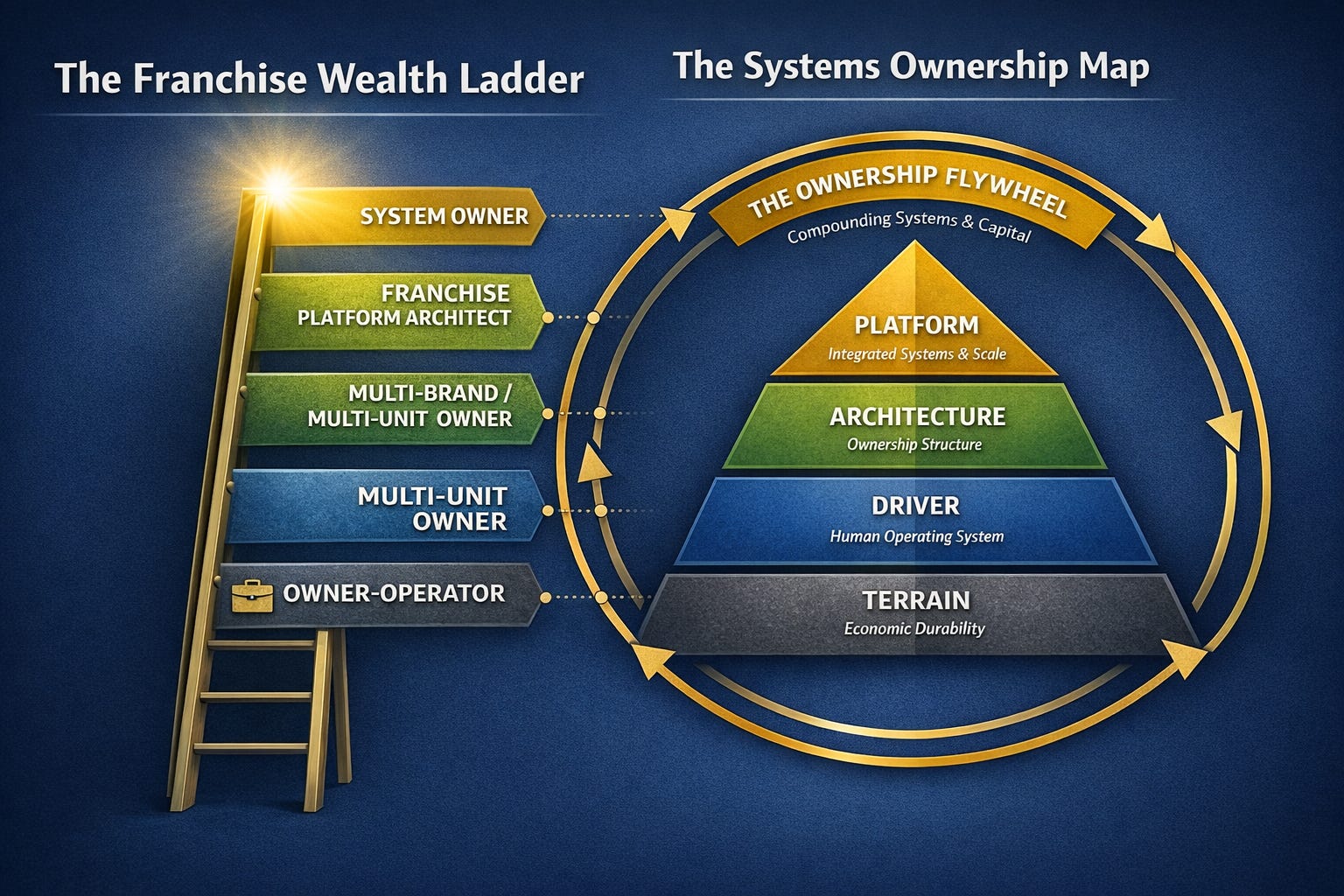
The real power of franchising doesn’t come from the first system; it comes from what happens after the platform exists. Once a well-designed platform is operating, growth stops feeling linear and begins to compound.
When operational infrastructure exists, every new system becomes easier to launch. The marketing systems, hiring pipelines, and leadership layers already work. So when a new complementary service is added, it plugs directly into the platform.
This is the Ownership Flywheel. One system supports the next, and the platform becomes easier to grow with each rotation. The operator is no longer managing individual businesses; they are managing local economic infrastructure.
6️⃣ Building the Quiet Empire
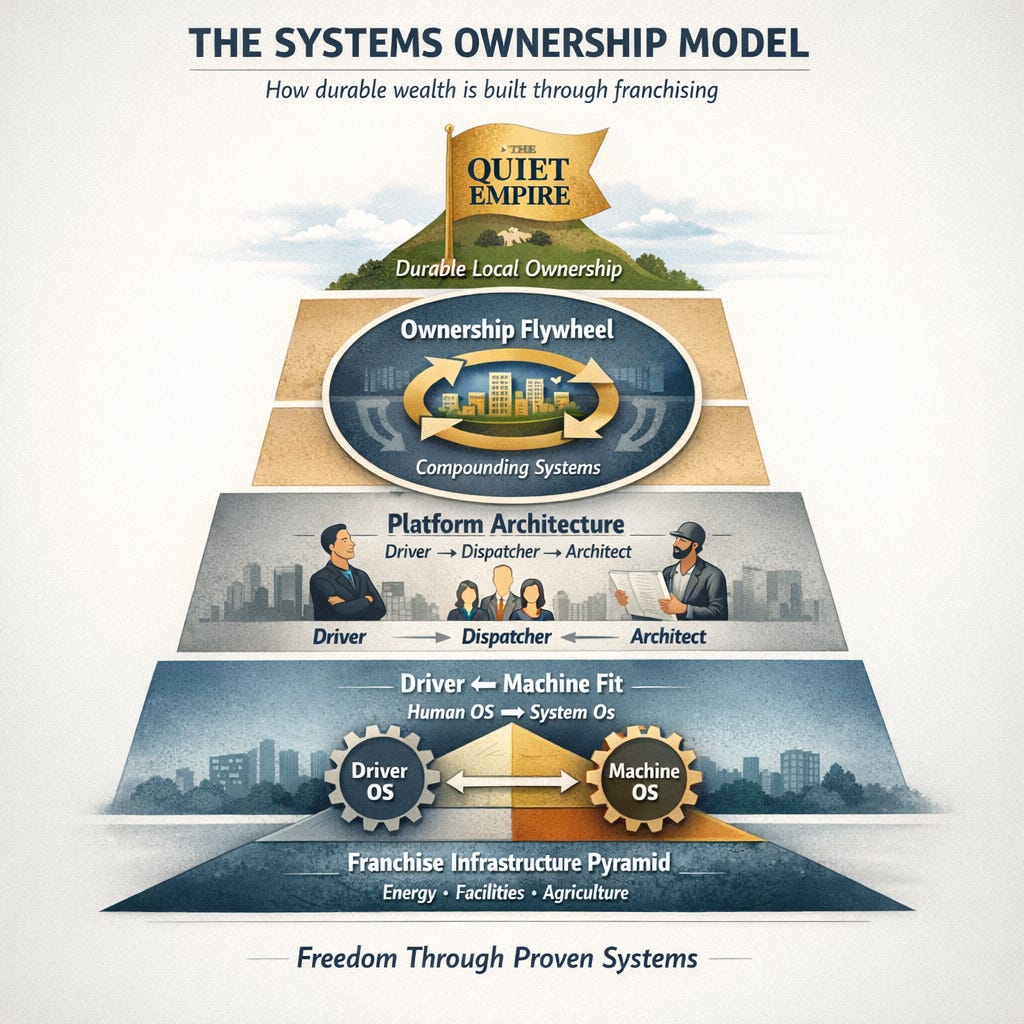
Over time, this system begins to resemble something private equity firms have understood for decades: durable wealth is built through the disciplined accumulation and integration of systems that produce reliable cash flow.
At the local level, a single franchise location becomes two. A complementary business is added that shares labor or customers. Over the course of a decade, what began as a single business quietly becomes something far more substantial. Not a startup. Not a brand. But a network of local infrastructure assets.
A quiet empire.
This is not about domination or scale for its own sake. It is about the ability to build stable, durable economic structures that provide autonomy, resilience, and community infrastructure.
For those willing to approach ownership with patience, discernment, and structural thinking, the quiet empire becomes a natural outcome. Freedom Through Proven Systems.