Freedom Through Proven Systems Is Not What You Think
Why structure—not escape—is what capable professionals are actually searching for

How to Listen
If you’d rather take this in as a conversation, this essay is also available as a podcast episode — exploring the same ideas around discernment, readiness, and why not choosing is often the most honest outcome.
🎧 Reflective Reading available — a slower, more spacious version with intentional pauses → Listen here
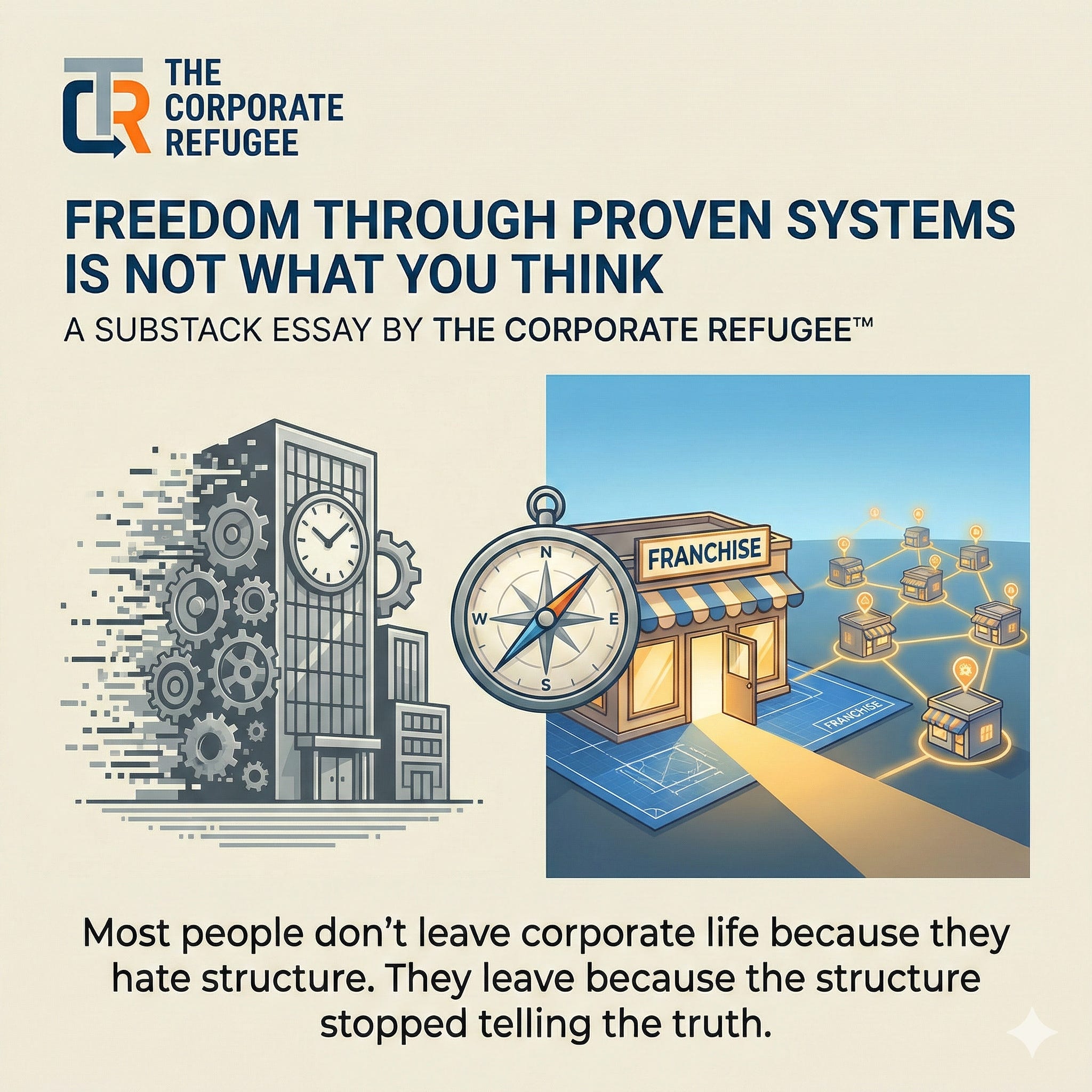
Most people don’t leave corporate life because they hate structure.
They leave because the structure stopped telling the truth.
At some point, the incentives drift.
The language becomes performative.
Decisions are optimized for optics instead of outcomes, speed instead of sense.
And for capable professionals—especially those who value coherence over chaos—that erosion is more unsettling than burnout itself.
What’s rarely named is this:
The desire to leave corporate life is often not a rejection of systems, but a search for a better one.
Not looser.
Not louder.
Not trendier.
Just… honest.
The Myth of Freedom as Escape
We’ve been sold a narrow definition of freedom.
Freedom as autonomy.
Freedom as independence.
Freedom as “no one telling me what to do.”
But anyone who’s actually built something—or led people through uncertainty—knows that unstructured freedom is short-lived.
What replaces the boss is volatility.
What replaces the org chart is ambiguity.
What replaces the paycheck is pressure.
Freedom without structure doesn’t feel like liberation.
It feels like exposure.
Which is why so many high-performing professionals don’t actually want to “burn it all down.”
They want alignment—between effort and outcome, responsibility and authority, values and incentives.
They want freedom through something that holds.
Why Systems Matter More After You Leave Corporate Life
Inside corporate environments, systems are invisible.
They’re ambient.
They carry you even when you’re not thinking about them.
Outside of them, systems become obvious—and unforgiving.
Payroll matters.
Process matters.
Culture matters.
Decision-making cadence matters.
So does who you listen to when things aren’t clear.
This is where many people make their first quiet mistake:
they conflate freedom with lack of constraint, instead of asking a harder question:
Which constraints actually protect my judgment over time?
That question doesn’t trend well on social media.
But it determines who stays standing five years later.
The Few Systems That Actually Endure
Not all systems deserve trust.
In the United States, there are only a handful of business structures that have demonstrated real durability across decades—not because they’re exciting, but because they reliably align incentives, distribute risk, and allow ordinary people to build extraordinary stability.
Most ideas don’t qualify.
Most models don’t survive scale.
A few do.
Historically, three systems stand apart:
Public markets, which reward capital and patience but require distance from daily control.
Real estate, which compounds slowly through leverage, stewardship, and time—but concentrates risk and demands tolerance for illiquidity.
Franchising, which sits somewhere in between.
Each requires patience. Each rewards stewardship. Each punishes impulse.
Franchising is not new.
It’s not experimental.
It’s not a shortcut.
It’s a system that has quietly scaled over 831,000 businesses, employs millions of people, and contributes nearly a trillion dollars in economic output—not by eliminating human judgment, but by standardizing what should be standardized and leaving the rest to the operator.
That’s why franchising matters in this conversation.
Not because it’s the only path.
But because it is one of the few systems that has proven capable of translating structure into opportunity—repeatedly—for people who don’t want chaos, speculation, or abstraction.
For professionals leaving corporate life, that distinction matters.
They’re not searching for novelty.
They’re searching for something that has survived pressure.
The Difference Between Growth and Durability
Growth is visible.
Durability is quieter.
Growth can be fueled by momentum, marketing, or timing.
Durability requires trust—earned slowly, validated repeatedly.
In franchising, this difference shows up clearly.
Some systems grow fast because they’re optimized for expansion.
Others grow steadily because they’re optimized for franchisee satisfaction.
Both can look successful from the outside.
Only one tends to compound trust internally.
And trust—not hype—is what most professionals are actually searching for when they consider ownership.
Not certainty.
Not guarantees.
Just evidence that the system won’t ask them to betray their values under pressure.
Why Franchisee Satisfaction Is a Signal—Not a Verdict
Franchisee satisfaction data is powerful precisely because it is limited.
It tells us:
Whether operators would choose the system again
Whether leadership behavior matches stated values
Whether the culture holds when things are hard
What it does not tell us:
Whether the system fits a specific person
Whether the timing is right
Whether the role aligns with someone’s identity or energy
This is where many lists—and many advisors—quietly overreach.
They treat satisfaction as a conclusion, instead of what it actually is:
a trust signal that still requires discernment.
A system can be healthy and still be wrong for you.
That doesn’t make the system flawed.
It makes the decision human.
Fit-First Decision-Making Is Slower—and Safer
Fit-first decision-making is not indecision.
It’s sequencing.
It prioritizes:
Readiness before acceleration
Due diligence before enthusiasm
Understanding before commitment
This approach is often uncomfortable for Achievers, who are wired for momentum and execution.
And it can feel overly analytical to Societals, who are motivated by meaning and impact.
But for both archetypes, fit-first thinking protects against the same risk:
Committing to a structure that quietly erodes who you are.
The cost of getting this wrong isn’t financial first.
It’s existential.
You can recover money.
Recovering alignment is harder.
Advisor-Guided Exploration Is Not About Speed
The best advisors don’t push answers.
They slow questions down.
They help translate system-level signals into human-level decisions:
What leadership style will this require of you?
How will conflict be handled here?
What kind of community are you actually joining?
What does success demand day to day, not just on paper?
This kind of exploration doesn’t produce viral soundbites.
It produces clarity.
And clarity is rarely loud.
Innovation Doesn’t Eliminate Judgment—It Exposes It
AI and data have accelerated access to information.
They have not accelerated wisdom.
If anything, they’ve made judgment more visible.
When tools move faster than readiness, the risk isn’t misuse—it’s misalignment.
Decisions get made earlier than identity can absorb.
The result isn’t failure.
It’s quiet dissatisfaction inside something that “works.”
That’s the hardest kind of misfit to name.
Culture Is the System You Feel First
People often ask about economics.
They should.
But culture is what they live in.
Culture determines:
Whether questions are welcomed or punished
Whether mistakes are corrected or concealed
Whether leadership listens when incentives collide
Culture is not the slide deck.
It’s the behavior that repeats when no one is watching.
For professionals who’ve outgrown corporate certainty, culture is often the deciding factor—even if they can’t articulate it yet.
They’re not searching for perfection.
They’re searching for integrity under pressure.
Freedom Through Proven Systems
Freedom, in its most durable form, is not escape.
It’s alignment.
Alignment between:
Responsibility and authority
Values and incentives
Effort and outcome
Proven systems matter because they reduce unnecessary risk.
Human discernment matters because no system can decide for you.
This is the quiet work.
The kind that doesn’t rush you.
Doesn’t flatter you.
Doesn’t promise certainty.
It just respects your intelligence—and your future.
A Closing Thought
Most people don’t need more options.
They need better questions.
Not:
“What’s the best opportunity?”
But:
“Which structure will still make sense when the novelty wears off?”
That question doesn’t demand urgency.
It demands honesty.
And for those willing to sit with it, freedom doesn’t disappear.
It clarifies.
—
Chris Tucker
The Corporate Refugee™
Freedom Through Proven Systems
This is the distinction I was trying to surface — not escaping process, but escaping bad process.
The moment you describe — realizing that “freedom” without structure just becomes exposure — is such a common (and rarely named) inflection point after leaving senior roles.
Appreciate you articulating it so clearly, and for extending the durability point. That reframing matters.