Employee Appreciation Isn’t a Holiday. It’s a System.
Appreciation treated as an event creates a moment. Appreciation treated as a system creates a culture.

Edition #13
Why I’m publishing this before the official day—and why the best leaders don’t wait for a calendar to tell them when to lead.
Author’s Note: I’m hitting ‘publish’ on this today, ahead of the official “Employee Appreciation Day.” Why? Because if we wait for the calendar to tell us when to value our people, we’ve already lost the plot. In durable organizations, appreciation isn’t a 24-hour holiday; it’s a 52-week system.
In a few days, the corporate world will gear up for the usual: lukewarm pizza, generic emails from HR, and performative LinkedIn posts.
But I’ve been reflecting on a different approach—a simple but powerful framework shared by David Rice (Startup Projects Director and operations leader). David outlined a 5-day approach to appreciation rooted in consistent leadership behaviors rather than one-off events.
What struck me wasn’t the complexity. It was the operational simplicity.
* No budget.
* No banners.
* No performative culture campaigns.
Just repeatable leadership signals embedded into the workweek.
From a systems perspective—especially in franchising and high-stakes operations—this distinction is everything. Appreciation treated as an event creates a moment; appreciation treated as a system creates a culture.
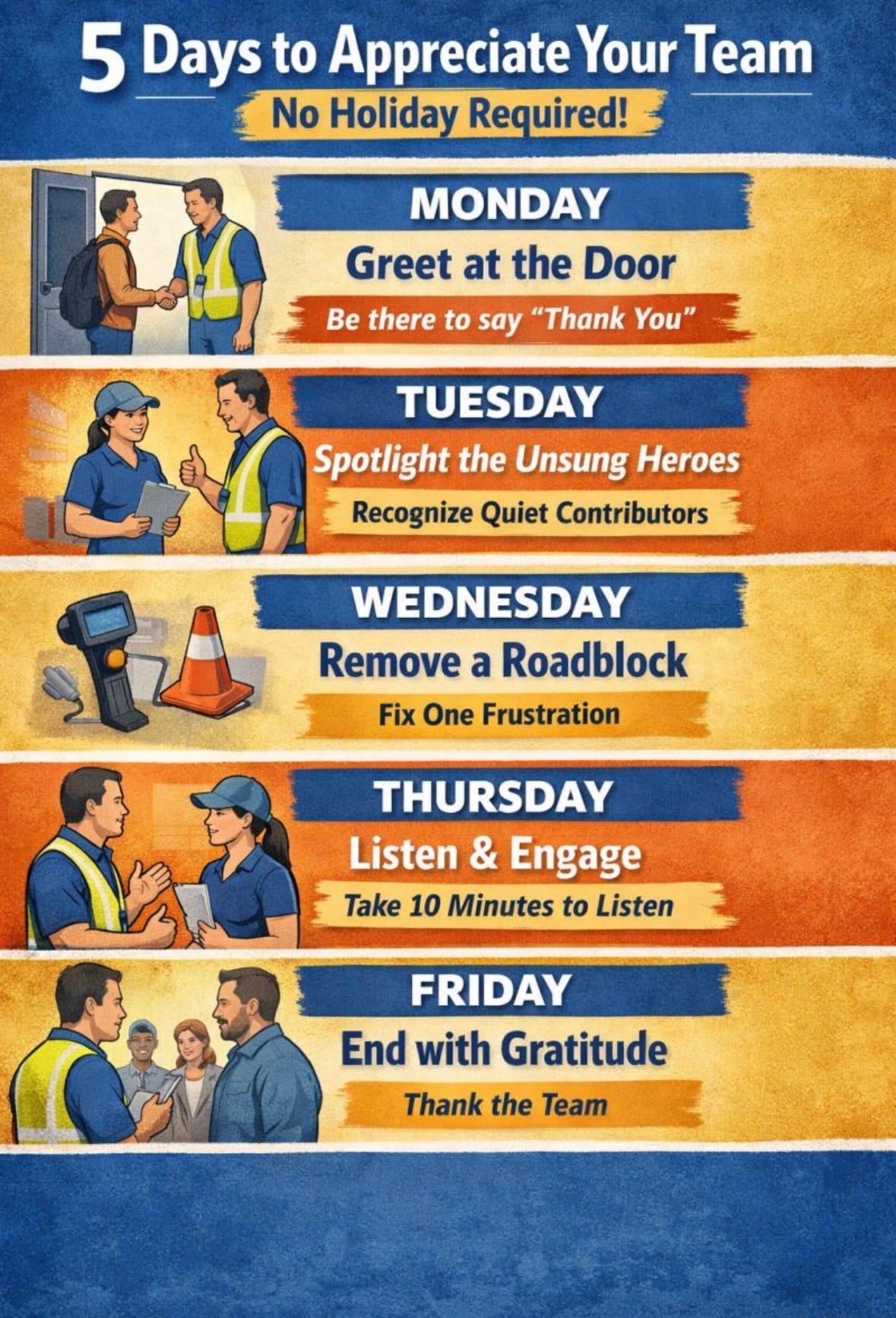
The 5-Day Appreciation System
(Inspired by David Rice)
Rather than reinvent the wheel, I want to look at David’s framework through a systems lens. The strongest organizations don’t rely on occasional morale boosts—they rely on consistent leadership rhythms.
Monday: Set the Tone at the Door
Be present at shift start or end. Make eye contact. Shake hands. Say, “Thank you for what you do.”
> The Systems Lens: This establishes psychological safety at the very start of the operational cycle. People remember how they are greeted long after they forget the metrics discussed in the 10:00 AM meeting.
>
Tuesday: Recognize the Quiet Contributors
Publicly acknowledge the people who do great work without seeking the spotlight: the operator preventing errors, the technician maintaining consistency, the “glue” people who keep the gears turning.
> The Systems Lens: In durable systems, culture is shaped by who gets recognized. This signal tells the team: The details matter, and so do you.
>
Wednesday: Remove One Friction Point
Ask your team: “What’s one thing slowing you down?” Then, actually fix it.
> The Systems Lens: This is operational empathy. Nothing communicates appreciation more effectively than making someone’s job easier. It’s a tactical investment in their daily success.
>
Thursday: Invest 10 Minutes in Listening
Walk the floor with no agenda. No phone. No rushing.
> The Systems Lens: In franchise and operational environments, frontline insight is your most valuable untapped data source. When people feel heard, engagement rises. When engagement rises, ownership follows.
>
Friday: Close with Specific Gratitude
End the week where leadership lives—on the floor or in the huddle. Share one specific win you observed.
> The Systems Lens: Generic praise is white noise. Specific gratitude reinforces repeatable behaviors. Repeatable behaviors build the system.
>
No Pizza Parties. No Optics.
What makes this framework compelling is what it removes. There are no forced celebrations or expensive initiatives. Just consistent, human leadership.
In my work with franchise systems and founders, I’ve noticed a pattern: The most resilient cultures are built through small, repeated signals of respect, not grand gestures.
“Employee Appreciation Day” shouldn’t be the peak of your effort. It should be a checkpoint. It’s a moment for leaders to ask:
Do my systems make people feel valued weekly?
Or do I only care when the calendar tells me to?
The Corporate Refugee Lens
In the “big corp” world, appreciation often becomes performative because culture is outsourced to an events committee. But for the Corporate Refugee—the person building something durable and real—appreciation is embedded into leadership behavior.
It’s not hype. It’s not optics. It’s just good operations.
Because in the end:
Processes don’t drive performance.
Dashboards don’t build culture.
Systems don’t execute.
People do. And people stay where they feel seen.
Credit & Acknowledgment
This reflection builds upon a leadership framework originally shared by David Rice on LinkedIn regarding appreciation as a weekly leadership practice. His simple and operational model inspired this systems-based interpretation through the lens of franchising, leadership durability, and culture design.