Decision Lenses
How thoughtful people choose without urgency, manipulation, or performance

Listen instead of read
If you’d rather take this in as a conversation, this essay is also available as a podcast episode — exploring the same ideas around discernment and readiness.
Last week, we talked about the cost of staying.
Not to provoke action — but to legitimize awareness.
Because before anyone leaves well, builds well, or changes anything responsibly, there’s a quieter task:
Understanding how you decide.
This matters more than most people realize. Especially now — when urgency is rewarded, decisiveness is applauded, and hesitation is misread as weakness.
But clarity doesn’t usually arrive as momentum.
It arrives as orientation.
Why smart people still make misaligned choices
If you’ve ever looked back on a major decision and thought:
“I knew better — why did I choose that?”
You’re not alone. And you’re not irrational.
Most misaligned decisions aren’t made from ignorance.
They’re made through inherited lenses — ways of evaluating choices that once protected you… But may no longer serve you.
We don’t decide in a vacuum.
We decide through filters — often invisible ones.
Until you name those filters, they decide for you.
What a Decision Lens is
A decision lens is not a preference.
It’s not a value.
It’s not a pro/con list.
It’s the dominant question your nervous system asks when faced with change.
Not consciously.
Automatically.
Questions like:
Will this keep me safe?
Will this be approved?
Will this matter?
Will this make sense long-term?
None of these are wrong.
But over time, one tends to dominate.
And when it does, every option starts looking the same.
Four common Decision Lenses
Below are four lenses I see repeatedly among high-functioning, purpose-driven people.
You may recognize one immediately.
You may recognize several.
That’s normal.
1) Security
“Will this reduce risk?”
Security prioritizes stability, predictability, and known quantities.
It’s often formed during seasons where safety mattered most.
The downside?
Security can quietly become constriction — especially when the system you’re in no longer reflects who you are.
2) Approval
“Will this be accepted?”
Approval prioritizes professional legitimacy, not disappointing others, and keeping the peace.
It’s common among responsible leaders, caregivers, and high performers.
The downside?
You can build an impressive life that no longer feels like yours.
3) Impact
“Will this matter?”
Impact prioritizes contribution, meaning, and usefulness beyond self-interest.
It’s powerful — and dangerous — when paired with urgency.
The downside?
You may rush toward “important” work without ensuring it’s sustainable.
4) Coherence
“Will this make sense for how I actually live and operate?”
Coherence prioritizes alignment between values, energy, and structure.
Sustainability over optics. Integration, not performance.
It often emerges later — not because it’s superior, but because it requires safety to access.
The downside?
It’s quiet. And quiet is often ignored.
A lived example: Principles over policy (and why this matters for fit)
One of the clearest telltale signs of a healthy system — whether it’s a franchise brand, a leadership team, or a personal operating model — is what happens when policy conflicts with purpose.
In my conversation with John Hewitt (founder of Jackson Hewitt, Liberty Tax, and Loyalty Brands), he describes a moment where a franchisee called just outside a defined service window — and an employee refused to help because “it’s past 4 o’clock.”
John’s takeaway wasn’t about customer service scripts.
It was about governance.
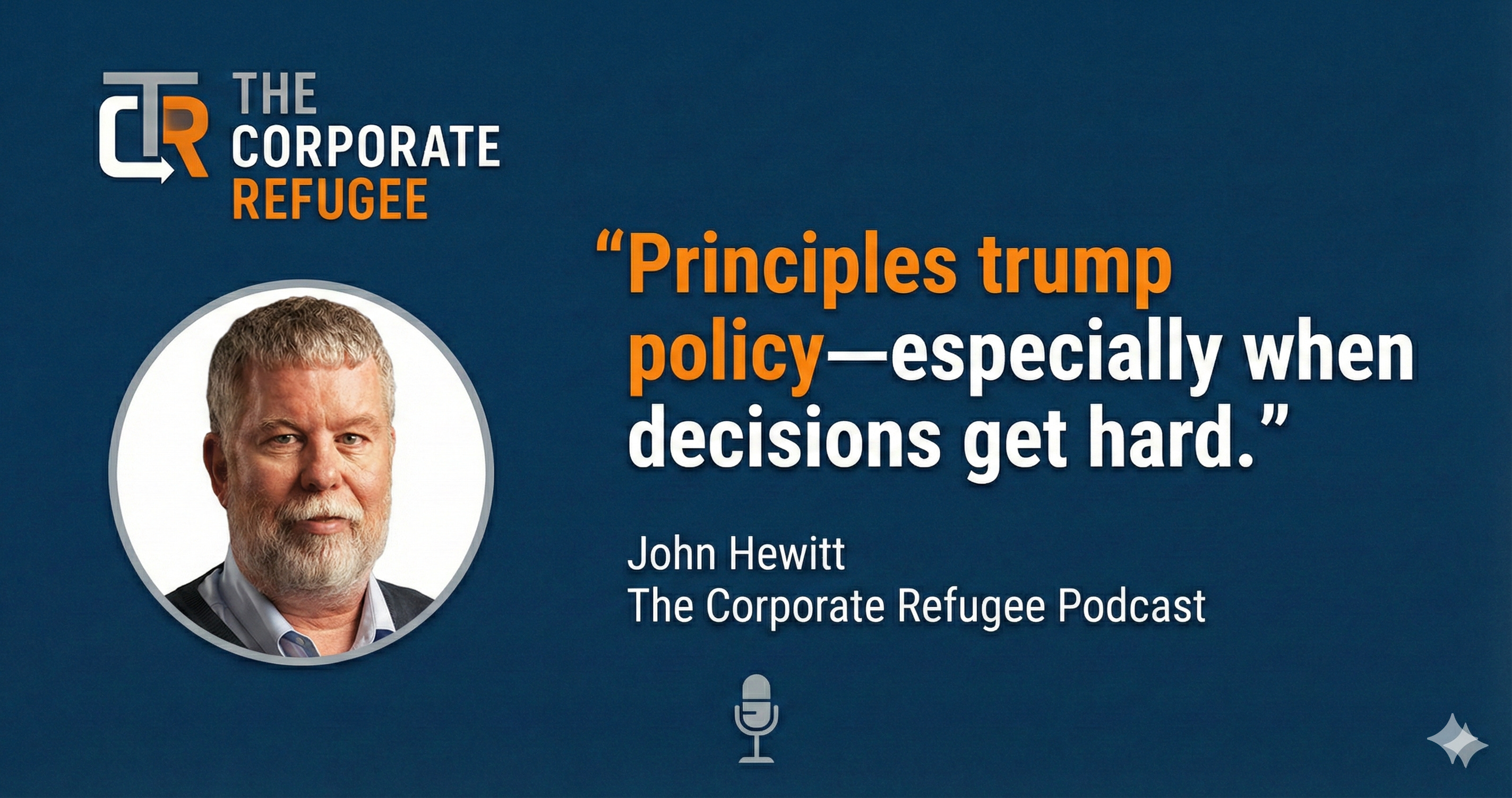
“Principles trump policy,” he said — because the principle is the real promise of the system.
Policies exist to support that promise, not replace it.
This is also why Fit-First Decision-Making matters so much in franchising:
Not “Is the model hot?”
But “Does leadership behave like franchisee health is paramount — even when it’s inconvenient?”
Because any organization can say “people first.”
The question is whether the system proves it under pressure.
Decision lenses don’t just shape personal choices — they shape how entire systems behave under pressure.
Principles before policy (why this matters today)
As we observe Martin Luther King Jr. Day, it serves as a reminder that history doesn’t move forward because rules were enforced more efficiently.
It moves forward because principles were held when policy was insufficient.
Systems that scale responsibly don’t ask, “How do we enforce this better?”
They ask, “What principle are we trying to protect as we grow?”
That distinction matters more than we admit.
When systems — personal or organizational — prioritize enforcement over judgment, they may look orderly on the surface. But they quietly lose coherence.
Over time:
People stop thinking
They start complying
And eventually, they disengage
Principles don’t eliminate structure.
They orient it.
And orientation — not urgency — is what makes change durable.
Why clarity feels quiet (and why that’s a problem)
We’ve been trained to expect clarity to feel like certainty.
Like excitement.
Like a surge of confidence.
But real clarity often feels… neutral.
Less noise.
Less urgency.
Fewer explanations.
That can be unsettling — especially in cultures that reward boldness over discernment.
History tends to celebrate outcomes, not orientation.
But movement without orientation creates chaos.
And action without coherence rarely lasts.
Clarity doesn’t shout.
It steadies.
Not choosing is still choosing
Here’s the part most narratives skip:
Pausing to examine your decision lens is a decision.
Refusing urgency is not avoidance.
It’s governance.
When you slow down long enough to ask:
Which lens am I using?
Why did this lens form?
Is it still the right one for this season?
You’re not falling behind.
You’re reclaiming authorship.
This is why orientation comes first
Before options.
Before opportunities.
Before business models, career moves, or next chapters.
Orientation answers a simpler question:
“How do I choose without betraying myself?”
Once that question is answered — even partially —
The right options stop needing to convince you.
They make sense.
What comes next
Next week, we’ll talk about fit — not as chemistry or compatibility, but as sustainability.
Not: “Can I do this?”
But: “Can I live like this — without erosion?”
For now, there’s nothing to decide.
Just something to notice.
You don’t need more options.
You need to understand how you’re making your choice.
That’s how coherence begins.
If you want to hear this principle tested in real leadership decisions:
Listen to this week’s episode on YouTube [TBA]
This week’s conversation with John Hewitt, founder of Jackson Hewitt, Liberty Tax, and Loyalty Brands, is a lived example of what culture, principles, and franchisee-first leadership look like when they’re practiced — not just discussed.
- Chris, The Corporate Refugee